  |
|
| ||||||
The next scheduled issue is for parshas Noach. 
We heard the following from the mashgiach of Yeshivas Orchos Chaim, HaRav Chizkiyohu Yosef Mishkovsky,:
"Many years ago, I spent several Yom Kippur days in the Kollel Chazon Ish. In one of those years, after Musaf and the avoda of the Kohen Godol, I noticed that the gaze of the Rosh Yeshiva, HaRav Shteinman, swept the room, as if he was looking for someone to whom he wished to speak.
"When I approached him, he turned to me and said: When the Kohen Godol emerged from the Kodesh Hakodoshim, he would only say a short prayer so as not to disconcert the public, as is described in the gemora in Yoma. These words revolved around the rains of the coming year: that they be plentiful and that the Jewish people would not have to support themselves one from another nor from other nations — among other material issues. Indeed? Yes.
"From here we learn the fundamental principal attributed to HaRav Yisroel Salanter, that the material welfare of another Jew is your own spiritual welfare and more. In other words, the concern for the body of Jewry and for the individual Jew was reflected by our leaders even on Yom Kippur."
The American president has a very short fuse. He demands results here and now, and it doesn't always work out for him. His dream was to end the war between Russia and the Ukraine in a jiffy, and achieve a historic peace in the hope that in Oslo, they would rush to award him with his most coveted prize. If the most despicable terrorist, a lowdown murderer like Arafat, reaped the award, and if former President Obama was awarded this prize after not having lifted as much as a finger to promote world peace, there is no reason why Trump shouldn't receive the prize if he did, after all, accomplish something.
But things don't work for him. He met with Zelensky from Ukraine and abused him before the whole world. He faced Putin in a most humiliating and futile meeting, and the war carries on without any end in sight.
Part 1
This essay was originally published in the Succos edition of 1996-5757 in anticipation of the following year when the 200th yahrtzeit of the Gaon fell out. This was 29 years ago. We are reprinting it because there is much of interest still today.
Our circles traditionally commemorate fifty year periods of the passing of gedolei Yisroel. Whenever a round figure elapses, a noteworthy date to conjure up memories, impacts and lessons, the public enjoys essays of esteemed evaluation. Sometimes the memories are brought to the fore orally at special public occasions or in memorial journals published expressly for that purpose in which the teachings, acts and exemplary conduct of that great person are reviewed.
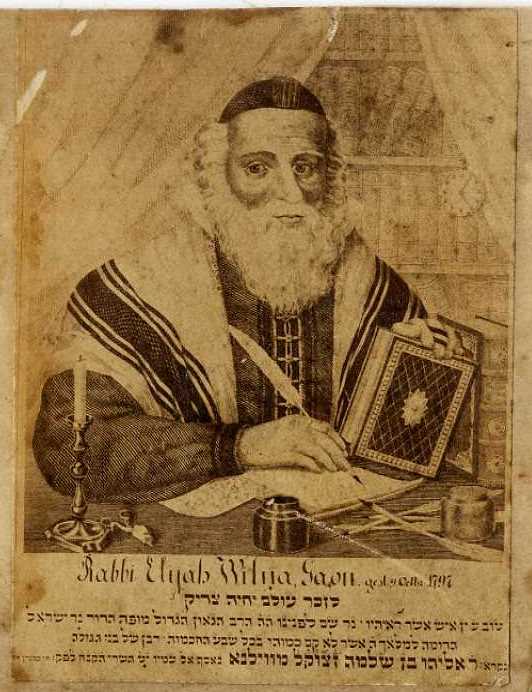
In these days, on the nineteenth of Tishrei to be more exact, the fourth day of chol hamoed Succos this year, 199 years will have passed since the demise in Tishrei 5558 of HaGaon R' Eliyohu of Vilna — known as the Vilna Gaon. The reader will surely wonder why this particular year is commemorated in our newspaper. Why has Yated seen fit to note the day of his passing one full year before the bicentennial of his departure?
We find in Chazal: "Rabbon Shimon ben Gamliel says: We do not make monuments for the righteous; their words are their very remembrance" (Yerushalmi Shekalim 2:5). If this holds true for every sage and leader of Israel, how much more does it apply to Rabbenu, the Gra of Vilna? He was the first since the period of the geonim who earned the universal title throughout the entire Jewish world of `gaon,' simply as is, without preface. All of the known Torah leaders regarded him as a sage of the stature of previous generations to the degree that they added to his title "the G-dly man" or even "the G-dly tana."
This is not the place to elaborate with awesome quotes of Torah sages. (I have expanded on this in a biographical work on the Gaon being prepared for publication.) Suffice it on this occasion to mention two, neither of them from his own disciples. The author of Tiferes Yisroel, on Mishna, writes: "The entire Jewish community sits under this single star which rises only once every thousand years, and falls from the sky only once to fill the entire world with light which is Torah."
The author of Haksav Vehakaballa writes of "that tzaddik, world genius, whose parallel does not exist on earth, a veritable angel of Hashem of Hosts, the awesome gaon [who was] like one of the rishonim."
Several divrei Torah mostly about Succos from the Gra.
From The Vilna Gaon
"Hide them in a succa from a quarrel of tongues." (Tehillim 31:21)
The mitzva of succa has the power to subdue the inclination to speak loshon hora and other forms of forbidden speech.
The Hebrew word "succa" is composed of four letters, each of which belongs to a phonetically different group of letters formed by various parts of the mouth:
The samech belongs with the "ZaSShRaTz" letters (zayin, samech, shin, reish, tzaddi) formed by the teeth.
This was first published in the print edition in 1995, that is, 28 years ago. This is the first time it is being published online.
From The Droshos Of HaRav Yosef Nechemia zt'l, the last rav of Cracow
"The posuk tells us, "And you shall take on the first day...", about which the medrash Tanchuma, parshas Emor comments, "the first day of reckoning sins."
Usually, if a king is about to visit a city in order to pass judgment on the inhabitants, deciding whether they are to live or die, everybody will run to him, in haste and confusion, each trying to make out a good case for himself and begging for his life. They crowd together, shouting and weeping. In their panic, nobody gives a thought to the state of his own clothing and whether or not he is dressed well enough to appear before royalty. Even the most destitute pauper, wearing coarse, torn garments of sackcloth, pushes along with the rest, ignoring his neglected appearance. He comes before the king crying and pleading and is judged to live. Suddenly, the king smiles at him and invites him to eat at the royal table for seven days.
When the poor man gets near to the palace, he looks at his clothes and surveys his appearance. Only then does he realize that in his present state he is unfit for royal company. Consumed by shame and embarrassment, he cannot bring himself to go dine at the kings table.
So it is with us, says HaRav Yosef Nechemia of Cracow...
This Google Custom Search looks only in this website.
Outstanding Articles From Our Archives
Opinion & Comment
Succos is called by Chazal zman simchoseinu, the time of our simcha. We are obligated to experience simcha, and the Torah summarizes the reason for the horrible punishments in parshas Ki Sovo, as due to a lack of simcha in our worship of Hashem.
There are many different types of simcha. In a famous incident in which he was visited by a maskil, the Vilna Gaon enumerates six different terms that are applied to simcha in Tanach: sosson, simcha, giloh, rinoh, ditzoh and chedvoh. Surely Succos is meant as our time of simcha in an inclusive sense, that we can fulfill the general mitzva of simcha through any of the various nuances. To be sure there are specific directives as to how to fulfill the mitzva -- eating meat, drinking wine, buying and wearing new clothes for the women and treats for the children -- but it is very instructive to consider the ideas themselves, especially for our time.
Opinion & Comment
"What the fool cannot attain on Yom Kippur at Ne'ilah, the wise man merits on Succos and Simchas Torah through simcha" (Hagaon R' Yisroel Salanter zt'l).
Vignettes from the memories of R' Moshe Eliezer Schwartzbard.
There was a period of simcha which descended upon the yeshiva immediately after Yom Kippur, to reside throughout Simchas Torah. All of the shmuessen revolved around the question why the Torah so stressed the aspect of joy on the Festival of Succos. And why did Succos merit the name "The Season of Our Joy"?
We enter our succas and come under the wings of the Shechina. We flee the strongholds of falsehood and rest in the protective shade of our booths, the fortress of our trust, for the succa shields us as did the Clouds of Glory. The Seven Shepherds come to visit our succa and gird us with faith and trust in Hashem.
At a time that the entire world still rocks from earthshaking events of all kinds, we are serene and full of confidence. The ground is secure underfoot and any hint or threat of gas warfare is a thing long past, for our nostrils are filled with the fragrance of the citron and myrtle.
The Simchas Beis Hashoeva that saved. A story.
A Story About a Tzaddik Who Never Attended Cheder
*
Who was that strange creature who just walked into the yeshiva? His hair disheveled and uncovered, his garb strange - - that of a maskil. The scene took place during the celebration of simchas beis hashoeva. Attracted by the music, the intruder's heart began throbbing with the "joy of mitzva," and from that time onward he remained put, there to stay.
Opinion & Comment
"And [Yaakov] rested in that place" (Bereishis 28:11). Rashi (ibid.) cites the Midrash to the effect that "[Yaakov] rested only in that place, but for fourteen years when he served in Eiver's study hall he did not sleep at night, since he was totally engaged in Torah study."
From where does a person obtain such phenomenal physical power, enabling him to study Torah for fourteen years straight without ever sleeping?
HaRav Chaim Shmuelevitz zt'l (Sichos Mussar, 5739, 9) explains that actually this was no miracle at all. The strength that HaKodosh Boruch Hu provides man with is tremendous, but the problem is that man does not make full use of it. When a person employs all the powers at his command, his accomplishments can seem miraculous.
We see, for instance, that when a fire bursts out, Rachmono litzlan, a person can carry a weight that normally only several people together can haul. "And they said, `We cannot [roll away the stone from the well] until all the flocks are gathered together . . . and Yaakov went up [to the stone] and rolled the stone from the well's mouth" (Bereishis 29:8,10) -- "just like a person removing a cork from a bottle, which teaches us that [Yaakov] was powerful" -- Rashi. The Rosh Yeshiva understood the midrash in its simple meaning: Yaakov had great physical powers.
The piyut of Tefillas Geshem, said on Simchas Torah (Shemini Atzeres in chutz la'aretz), teaches us that Yaakov's strength stemmed from his ability to dedicate his heart entirely to Hashem. "He dedicated his heart and rolled a stone off the mouth of a well of water . . . For his sake do not hold water back." If his strength had been merely natural we would certainly not be mentioning his zechus to save us from drought. Yaakov's strength of being able to dedicate his heart enabled him to study in the beis midrash of Eiver for fourteen years without ever sleeping, and to roll away the stone from the well like a person removing a cork from a bottle. Only our laziness prevents us from realizing our capabilities.
|
||||||
.jpg)