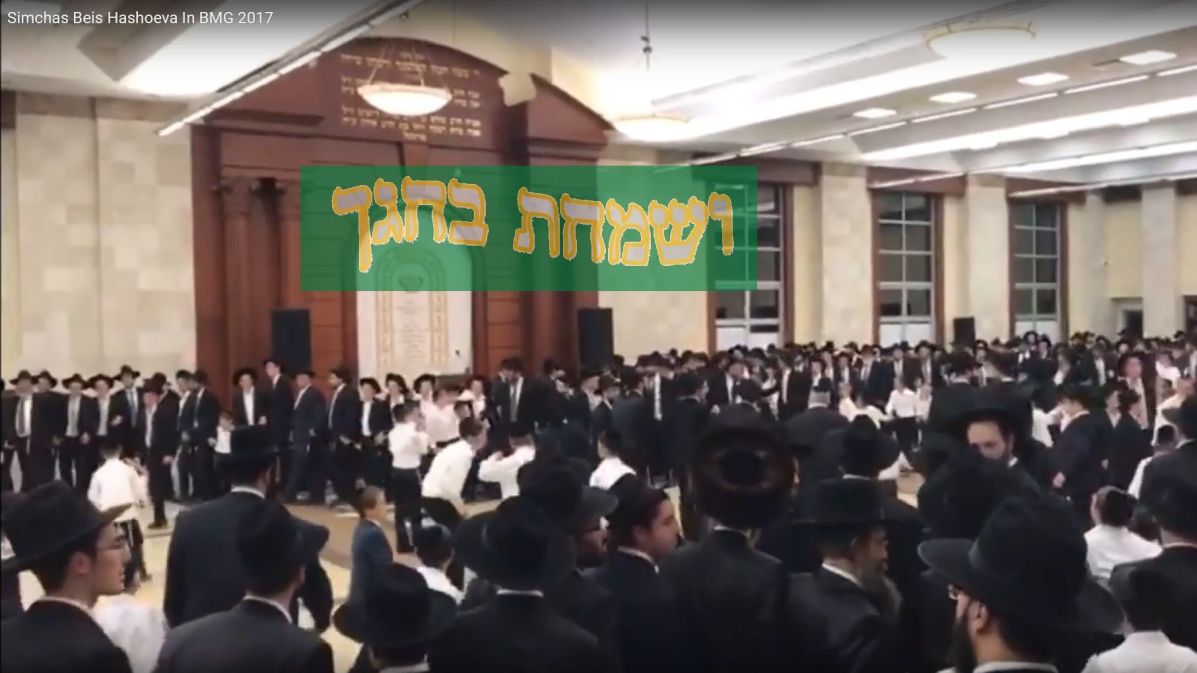
"Whoever did not see the Simchas Beis Hashoeva never saw joy in his entire life....pious men and men of deeds would dance before them with fiery torches in their hands" (Succa 51).
"Tannu Rabbonon: Some of them would say, "Happy was our youth that has not shamed our old age"—These were the pious men and men of deeds...Tanya: They said of Hillel HaZaken that when he was rejoicing at the Simchas Beis Hashoeva he used to say, "If I am here—everything is here! And if I'm not here—then who is here?"
"He would say, "My feet carry me to where I love. If you visit my house, I will come to your house but if you don't come to my house—I won't come to your house, as it says (Shemos 19) "In every place.." (Succa 53a)
Hillel always serves as the model of humility, as we see in a number of places in the gemora, for example: "A person should always be humble like Hillel, and not severe like Shammai." (Shabbos 30:) "It was Hillel's humility which drew us under Hashem's protection." (Shabbos 31).
The quotation from Hillel, "If I am here, everything is here," which he would say at the Simchas Beis Hashoeva seems especially strange in view of Hillel's humility and patience. We present here eight explanations of Hillel's words collected from the sifrei acharonim. At this time we will present only four.
Where Ruchniyus Is Concerned—Don't Leave It Up To Others!
Rav Tzvi Markovitch, rosh yeshiva of Karlin and member of the Moetzes Gedolei HaTorah of Degel HaTorah, explains using the following moshol. The mispallelim of a certain shul, who were not men of means, were envious of their well-to-do brethren at another shul nearby who were able to provide all their members with whiskey to drink on Simchas Torah between the hakofos. As a result, the joyous atmosphere in the well-to-do shul was literally out of this world.
"How can we arrange it so that we too can enjoy a drink on Simchas Torah like they?" they wondered.
One of them came up with a simple idea. "We'll set up an empty barrel in a corner of the shul and every Shabbos at Mincha everybody will bring a small glass of whiskey left over from the morning's seuda and empty it into the barrel. Over the year, the barrel will fill up and then on Simchas Torah our joy will also be complete!"
They were pleased with this suggestion and each week as planned, everyone appeared for Mincha on Shabbos carrying a small glass which was emptied into the barrel. On Simchas Torah they eagerly dipped into the barrel, filled their cups but were bitterly disappointed by the nonalcoholic taste. The barrel was full of water.
Speechless, all they could do was stare at one another. There was no blame to apportion, for each one recognized his own guilt. They had all had exactly the same idea, reckoning that if everyone else brings whiskey, it will make no difference if he alone brings water.
It is exactly the same with advancement in ruchniyus, improving middos, etc. Everybody knows he has to advance and improve his avodas Hashem, but they often prefer to wait for somebody else to go first. The end result is that nothing happens.
Hillel HaZaken, coming to discourage this tendency, said, "If I am here, everyone is here." If I want to see the whole world perfected, I have to see to it first and foremost, that "I" am here. Only if I am concerned with my own perfection, is there a chance that everyone else will also improve but "If I am not here," if I wait for others to get the work done before me, then "who is here?" (Quoted in Yalkut Lekach Tov, Parshas Shemini )
And All Your Actions Should be Lesheim Shomayim
(HaRav Moshe Feinstein in Darash Moshe)
Nisuch HaMayim comes to show that everyone, even the poorest pauper, can ask Hashem for the year's geshem, that is, that Hashem should grant him a good year and abundant blessings. Anyone can approach Hashem with his requests even if he is unable to offer many korbonos or give a lot of tzedaka because "both he who does a lot and he who does a little are equal"—it is a person's heart that Hashem wants, meaning that everything he does should be with the intention of serving Hashem. We see this from the fact that merely by pouring water out before Hashem, lesheim shomayim, a person is blessed with the year's rain.
From here we learn that whatever it is that one is doing, if he does it with a pure intention of thereby serving Hashem, he becomes a complete human, for whom the world was created, and his actions are pleasing to Hashem. If, on the other hand, he doesn't act out of a desire to serve Hashem, then he is worthless. Even if he may perchance do something good, if it is not done for the sake of heaven, but from his own motives, it is also not worth all that much.
This is the reason for the great rejoicing associated with Nisuch HaMayim, more than with any other mitzva. This mitzva encourages every man and teaches that he can achieve completeness with whatever means Hashem has given him, through each one of his regular daily actions, even without being wealthy.
This is what Hillel explained, "If I am here," meaning that if, in my actions, Hashem is here and everything I do is in order to serve Him, then "everything is here"—even when neither financial sacrifice, nor trouble are involved, even when simply eating, drinking and doing other physical activities with the intention to serve Hashem, a mitzva is being done and true perfection is achieved. This is what, "everything is here," is referring to.
"If I am not here," and a man does not live lesheim Shomayim, then "who is here?" Everything is worthless vanity. This is what we learn from Nisuch HaMayim.
This is also what Hillel went on to say, "To the place I love, my feet take me," meaning that when a man lives his life lesheim Shomayim, then even when he walks in the marketplace, does his work, eats or drinks it is as though he is going to the beis hamedrash to learn or pray. Since he is acting lesheim Shomayim even his physical needs are a great mitzva and take place at Hashem's table.
I explained elsewhere (on Shabbos Nachamu of 5683) that the posuk (Shemos 20:9) "For six days you shall work" is also a mitzva if undertaken in order to serve Hashem, and if not, then even if he goes to the beis hamedrash he may end up behaving incorrectly, spending his time in idle talk, interrupting krias HaTorah and chazoras hashatz and speaking loshon hora even in a holy place. This is what Hillel meant by, "where I love, my feet take me."
He said further, that Hashem addresses us and says, "If you come to My house," meaning that all your actions are lesheim Shomayim, and it is therefore as if you were always going to the beis hamedrash and continually dwelling in Hashem's house, then "I will come to your house," your affairs will prosper and Hashem's blessings will be evident in your house.
"If you don't come to my house," and do not live your life in My service, then you will not see prosperity, for "I will not come to your house," as the posuk says "wherever I mention my name" which means, "If my name is mentioned everywhere through you and you live lesheim Shomayim, then I will come to you and bless you."
Hashem Desires The Heart
(HaRav Shmuel Rozovsky in Zichron Shmuel, mussar section, page 598)
If one's "I" is always present in his actions, in his praises of others and in his expressions of joy, then "everything is here." If his actions spring from his innermost heart, where the real person is, that is everything. If the "I" is not there, and what he does is external, not coming from deep inside, then "who is here?" It is all nothing.
A person's every action has to be as described by the posuk "you wanted certain truth." Hashem wants the truth to be firmly rooted within us "in certainty," that is, even at the deepest levels of the personality, which we are not normally aware of, there we have to bring in the truth and anchor it firmly.
In his commentary, Rabbenu Chananel brings the following girso in the Yerushalmi on Hillel's words. "When Hillel HaZaken saw them serving (Hashem) frivolously, he would say, "Does He need their praises?" The posuk says, "Thousands upon thousands serve Him!"
When he saw people serving Hashem correctly, he would say, "Were we not here, who would be here? Even though there are many praises before Him, the ones which are dearest to him are those of Yisroel, as the posuk says "the pleasant singer of Yisroel" and, "and You are holy, Who sits (and receives) the praises of Yisroel."
When they served Hashem frivolously, without correct intentions and genuine feeling, even though they may have intellectually understood, they were not motivated by the feelings of their hearts. Then Hillel asked, "Does Hashem require the praises of these people when He has thousands upon thousands to serve Him?"
He doesn't want avoda which involves only the intellect. For this kind of avoda, the Mal'ochim whose intellectual recognition is clearer than ours, are far superior in singing Hashem's praise.
What Hashem desires from humans is that we serve Him with our hearts. This is where humans are superior to Mal'ochim. For this kind of avoda mankind was created, in order to serve with the heart, feelings and emotions. This is what Dovid Hamelech meant when he described Hashem as "sitting (and receiving) the praises of Yisroel," for it is our task to bring our thoughts and feelings together and to sing Hashem's praises with harmony between the two."
According to this explanation, the Yerushalmi's version of Hillel's words, although worded differently from the Bavli's, bears in essence the same message.
The continuation, "To the place I love, my feet take me," can be understood in the same way. What the "I" loves, the true innermost desires of a person are what the person's feet will move towards.