| | Feature
The Jews Called Him King: R' Dovid Oppenheim
by N. Aviam
Part 3
This was originally published in 5636.
For Part II of this series click here.
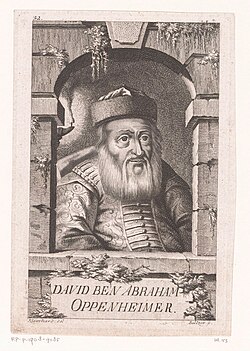
In the first two parts we learned about the life of HaRav Dovid Oppenheim. This part is about his magnificent library, very large for its day.
The Famous Library
It seems as if nearly every printed sefer in existence could be found R' Dovid Oppenheim's library. Amassing so vast a collection demanded much effort on R' Dovid's part. This project spanned a period of fifty years, during which he spared neither time nor money in order to acquire every sefer available to him. Where seforim were concerned, money was no object to him. Whether at a fair, or on journeys for the needs of the klal, he searched for seforim and manuscripts to enrich his library, recruiting his relatives and paid agents for this purpose too.
These agents were sent to seforim owners who were selling their books. With their satchels of money in their hands, they paid whatever price the owner of the books demanded.
A Sefer from the Library
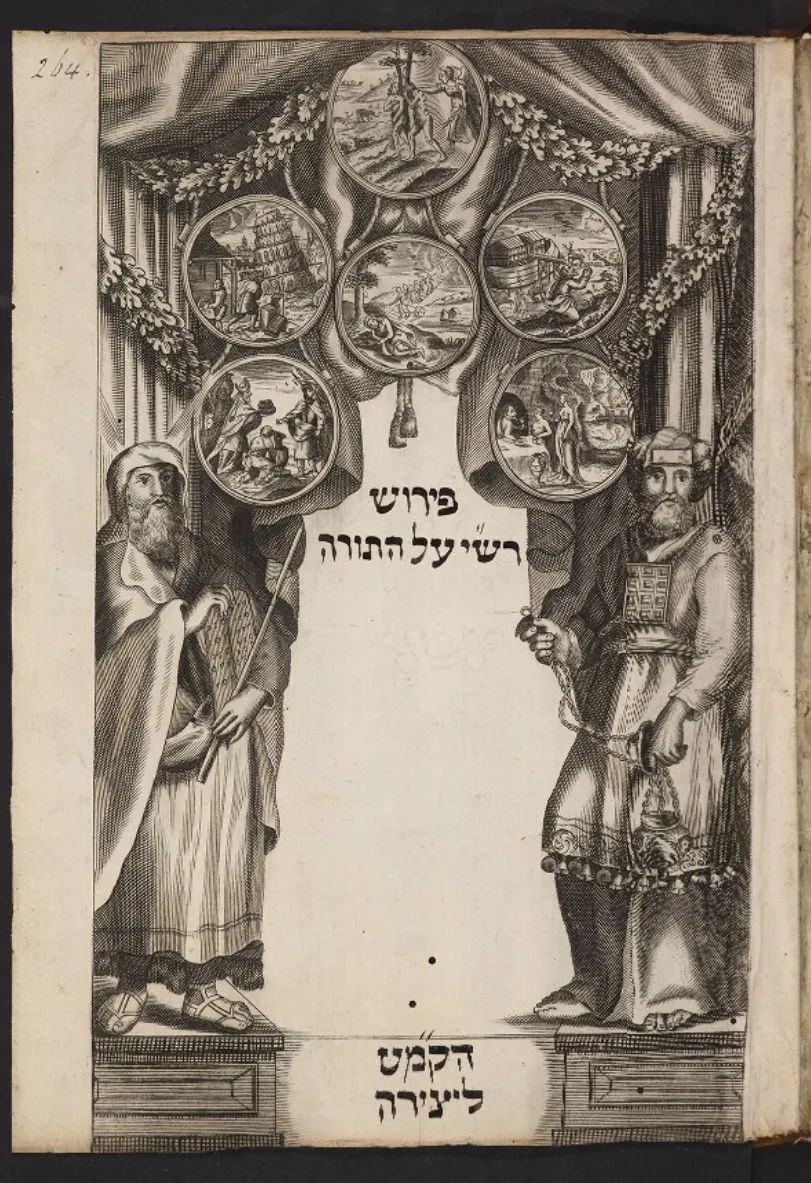
An example of this practice is found in a letter he wrote to R' Meir Katznelbogen, author of Ner LaMaor: "Regarding the seforim which are listed, I spoke with the aluf, R'P, who agreed to sell kvod Toraso all of them together.... and if maalas kvod Toraso wishes, he will give them to him for forty reinisch."
In the event that the owner of a book or a manuscript didn't want to sell his treasure, R' Dovid Oppenheim had a solution. He would hire special scribes to copy these books word for word from beginning to end, in the home of their owner. He also kept scribes in his own home, to recopy difficult-to-read manuscripts into clear handwriting.
Scores of Jews thus found a source of livelihood, and served as the foundation for enriching the library, which functioned according to the format of any modern library worthy of its name. The difference, though, between modern libraries and that of R' Dovid Oppenheim, was that he subsidized the entire effort on his own.
He not only invested his money and his time in printed seforim, but also in still unpublished ones. While in the printing stage, he would approach the printers, and ask them to invest in the best kind of paper and ink, at least for a number of copies. From such editions, at least one, or sometimes a few of these luxurious copies would reach his library. This isn't very understandable to us. But in those days, not all of the books of one edition were of the same quality. R' Dovid purchased of course, the choicest and the best.
In a letter to R' Tavlin HaKohen, he writes: "Many types of people have come to me with interpretations for the chiddushei halachos of the Maharsha, published in Frankfurt, and proofread without any errors, by maalas kvod Toraso. Therefore, I hereby declare that wherever you have proofread, it has been done clearly. I saw two proofs... one more excellent than the other, in their beauty and in the quality of the paper and the ink. Since there are certain copies which are better than the rest, I ask... if you can select me one of the choicest from the printing house, and give it to the agent I have delegated for this purpose."
Many prominent books merited a special place in his library. These important works, among them siddurim, Chumashim and machzorim, were printed for him on parchment. In 5475, when the Shas was printed in Frankfurt, one copy was printed on special doe parchment for R' Dovid. This Shas was bound with a white leather cover, on which special golden letters were engraved. Librarians and experts say that, according to their knowledge, this is the most beautiful Shas in the world. R' Dovid paid the printers 1000 reds for it.
This description portrays R' Dovid Oppenheim as a very wealthy person with strong bibliophile tendencies. However, R' Dovid wasn't a collector, and there is a tremendous difference between him and book collectors. The book collector lifts his treasures gently and carefully. A guest who comes to the collector's house, will certainly not be able to touch these precious items or to read them. Loaning them to someone else is out of the question. Such was the situation with rare books and manuscripts in the cellars of the prominent libraries of those times. Only the international law obligating libraries to open their storehouses to researchers led to the discovery and publication of books and manuscripts.
But R' Dovid Oppenheim's attitude toward his books was totally the opposite. Despite his great love for his seforim, and the tremendous amount of money he invested in securing and maintaining them, he wasn't acquisitive. This library served as a tremendous chessed institution (for scholars and for the many Jews who found their livelihood there), and in a rare manner too.
Whoever came in search of a book, would not only find what he wanted, but would also be offered assistance. Thus we find that the works of gedolei Yisroel contain quotes from books which they found in the library of R' Dovid Oppenheim.
But that wasn't all, for he let rare books and manuscripts be taken out of the library too, (something which today is not permitted). Regarding this, we find a letter of the gaon, R' Yochonon Kramitzer who writes: " ...I also have a work which I wrote on Nozir, which no other commentator in the world has looked at, and is full of mistakes, even more than Seder Kodshim, especially the Tosafos... Perhaps you can find a parchment Gemara on Nozir, transcribed before the printing of the Shas, so that I might be able to locate the mistakes."
R' Shmuel Kahane writes to him: "I asked for the book Koton sheHigia leChinuch... Can you be so kind as to send it to me by mail?"
But with that his tzidkus didn't end. When anyone wanted to print something from the manuscripts in his library, R' Dovid not only gave him permission, but also subsidized the printing. All that the publisher had to do was take the trouble to bring it to print. The manuscripts and the money would come to straight his home, directly from Reb Dovid's. So it was with the manuscripts of the Rashbam; the Ritva on the Torah; the Ritva on Chulin, and the Rosh on Zeraim.
The history of this library was also distorted and falsified by Graetz. The book-loving maskilim of Germany, regarded the maintenance of such a library as an indication of a high cultural level. It bothered Graetz that a Rav of the old-style had so great a love of books.
But he found a "reason" for this too: "Reb Dovid inherited the core of the library from his uncle R' Shmuel Oppenheim, who received the books from Prince Eugene. The books were taken as booty by his army from the Jews of the lands in which he fought. The collection was a gift, in gratitude for the financial aid which R' Shmuel Oppenheim had extended him."
A Sefer from the Library
In this way, Graetz "proved" that it wasn't a high cultural level which spurred the establishment of the library, but that the books were merely booty left over from the war between the Christians and the Turks.
This lie joins the other lies which were already disproved in our previous article. In addition to the fact that the story about the booty has no reliable source, it is totally disproved from the responses themselves. The library's catalog, which was compiled when Reb Dovid was still alive, mentions only one book which was given to him by his uncle, R' Shmuel Oppenheim. Throughout all of the letters which speak about the books, the process by which they were purchased is described.
In one response to the gaon, R' N Katz, author of Smichas Chachomim, Reb Dovid tells about his first library in Worms, his native town :"...[those] which Hashem's hand destroyed in the year 5449, and which Hashem, in His anger caused to burn... All of the books word burned, due to our many sins..."
At that time, his uncle was still alive. Thus, even before receiving the legacy of his uncle, he had a love for seforim. However, Graetz never saw all of these teshuvos and letters, and fabricated ridiculous stories whose purpose was to degrade and disgrace every "uncultured" talmid chochom. Woe to such "culture!"
The expenses of maintaining the library were also incurred by R' Dovid, for after all, the publisher was a guest, and why should his lot be any worse than that of a guest?
His co-generationists merited to benefit from this remarkable library. The only one who barely derived pleasure from it was Reb Dovid himself.
When he was in Nicholsberg, the library was housed in his private dwelling. At that time, Reb Dovid was immersed in his Torah, studies and would make constant use of his seforim and manuscripts. In his responses, we find a copy of passages, in which he stresses that he had copied a complete stanza, because it was not available. He relied on the many seforim which were found in written form, and on those which were printed. However, as attested to by his response to the Chavos Yair, in his possession there were even more accurate versions of the Sefer HaMordechai, which I have is proofread."
When he was appointed Rav of Prague, he didn't take his library with him because the Jesuit monks, whose center was in Prague, took care to erase and destroy every Jewish book. Bringing a book into Prague without the permission of the censor was a very serious crime. They were even stricter about manuscripts.
In a special letter, the monks persuaded the authorities not to allow the library to be brought into Prague. Among other things, they wrote: "Who knows what curses and anathemas against Christianity are hidden in these writings — curses known only to the Jews. This is especially so because most of them come from Turkey, where Christians are despised." The library remained in his father-in-law's home in Hanover.
Over the years, it became obvious how Hashgacha had acted in this manner, for in 5474, a decree to burn all of the editions of the Talmud and the commentaries on it, befell Prague. Had the library been in Prague, not a vestige of it would have remained.
Hanover was the second station in the wanderings of this rare library. After the death of R' Dovid, its more difficult wanderings began. It was inherited by his only son, the gaon, R' Yosef, av beis din of Helshoi.
After his death, only two years after his father had returned his pure soul to his Maker, the library underwent a number of transmigrations. The heavy debts incurred by the owners resulted in the confiscation of the books by the Prince of Hamburg, and their being offered for sale. Strangely, no buyer was found for this library, despite its constantly decreasing price. This intricate and wearying process continued for over sixty years.
Already in 5524, a partial inventory of the books was made, for the purpose of their sale. After about twenty years, a second list was made — and this time a complete one. But this time too, nothing was done. After this, the library's proprietor was sued for his debts, and for scores of years their sale was forbidden.
In 5586, when the books were confiscated, their sale was publicized among the non-Jews. Ministers and princes, professors and institutions were interested in acquiring them, but in vain. The German maskilim sought to take over this library. Mendelsohn, the head of the maskilim tried to influence people to buy this treasure. For years a call to "the wealthy among us" to invest in this deal appeared in their literary arm, HaMeasef. But even when the price dropped to six thousand Reichtalers alone, no buyer could be found in all Germany.
The Bodlean Library

In 5589, over ninety years after the death of R' Dovid Oppenheim, the library reached its final station, when the Bodlean Library of Oxford bought it in its entirety for nine thousand thalers (1350 lira sterling). The value of the library at that time was estimated to be 200,000 thalers. But as one of the experts on the subject said, "Never has a library acquired so much for so little."
The maskilim of Germany were aghast. This was a severe blow for them. One of them explained their feelings with these words: "To our great shame, and to the shame of the wealthy Jews among us, our portion has become the lot of strangers, our homes have been given over to gentiles. And now this library is in the center of Oxford, through which no one passes and where no one resides."
Regarding the Jews of Oxford, this "chochom" writes: "They are as aware of the wonders and treasures in this city (i.e. the seforim), as a donkey who bears seforim on his back knows what he is carrying! Woe that our portion has fallen into the hands of strangers."
The author, G. Karsel writes about the hypocrisy underlying this cry: "Such a cry, from the mouths of the maskilim of Germany really meant: `Why in our great foolishness, did we allow the treasure to be transferred to the library of England, when we could have left it behind in a non-Jewish institution in Germany?"
Why a non-Jewish institution? Because in Germany at that time there were no Jewish public institutions. This was because the maskilim opposed such institutions, which would smack of too much Jewishness, and too little of the German patriotism to which they aspired.
Looking back, we see that bechasdei Shomayim the library was saved by its transfer to England. Had it remained in Europe, it is nearly certain that it would have been at least partially destroyed by the Nazi beasts.
This purchase raised the small Oxford library to a level of the most prestigious library in the world. There is barely a person alive today who has not heard about the Jewish treasure which nestles in this small town. Most of the books are the seforim of the gaon, R' Dovid Oppenheim.
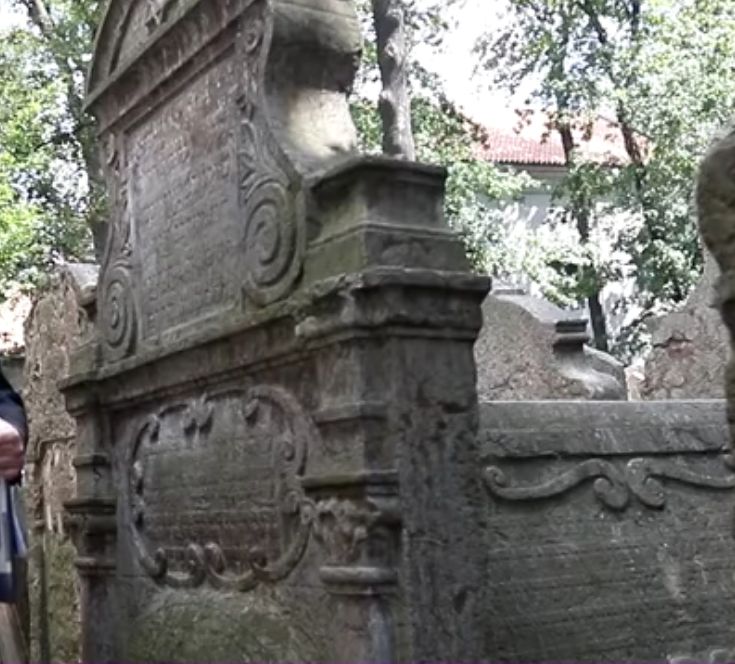
The Grave of Rav Dovid Oppenheim
What is interesting is that among the storehouses of R' Dovid Oppenheim, were his very own works, among them Nishal leDovid, as well as his chidushim on the Shas; droshos on the Torah and many other manuscripts. However, when the library was bought by the Bodlean Library, his writings weren't among the items purchased. Only twenty years later, when the Bodlean Library bought the books of the collector, Chaim ben R' Yosef Michel of Hamburg, were the writings of R' Dovid also purchased. How they reached this library is also amazing. However, Hashgacha caused them to reach the University of Oxford too.
From these writings, Nishal leDovid was published in three volumes. In that way, part of the writings of he who made so great an effort on behalf of the oral and written Torah, were redeemed. Even today, all of the writings of the rishonim which today appear in print, are taken from the manuscripts found in R' Dovid's giant collection, and are the outcomes of the efforts and toil of this great tzaddik.
As we said, the publishing of Nishal leDovid which clarifies the business dealings of a tzaddik, is only a beginning -albeit a very great and prestigious one. For the first time, after hundreds of years, the writings of he whom the Chida called "godol hador" are being published. In addition to the publication of his works, the discoveries about his life, which emerge from these writing, constitute an additional chessed. Already, a magnificent Torah figure has been revealed, and the terrible distortions of the historians shown to be false.
On a Wheelchair
The publication of Nishal leDovid should also be mentioned. The project was undertaken, with unusual dedication by the publisher, Rav Yitzchok Dov Feld zt"l, who devoted himself to putting out the works of gedolei Yisroel. Rav Feld, Rav of a community in England and the disciple of the Hungary's gedolim, lived through the Holocaust. As the one to "discover" R' Dovid Oppenheim, he decided to devote himself to the publishing of his works.
Rav Feld, who is paralyzed in both his legs, did not spare any effort to achieve this aim. One day, he and his devoted wife arrived in the small town of Oxford, which contains very few Jews, and surely no Torah observant ones. Laden with homemade kosher lemehadrin food supplies, they rented a room and set out to work.
But the rebbetzin, who with great effort pushed her husband's wheelchair up the stairs leading to the prestigious Bodlean Library, was in for a surprise, for British libraries are unlike those in the United States or Eretz Yisroel. Anyone who wants to spend the day in an American or an Israeli library is free to do so, and for many, libraries are places of amusement, or places for just wiling the day away.
But in Oxford, things are different. If you're bored, say the British, spend your time elsewhere, and not in the Bodlean Library! The library has an explicit purpose, and who ever wants to sit there has to state his reason. But the British mind knows no compromise. Rules are rules! Thus, Rav Feld who had come to the library for a specific purpose was allowed to enter, while his devoted wife, had to remain outside. Every day, she would bring her husband to the gates of the library, and then sit outside until afternoon, waiting for him, in the snow, the rain or the heat. But the effort proved worthwhile, when three luxurious volumes of the responses of the great gaon, R' Dovid Oppenheim were published. For this we owe Rav Feld zt"l a deep debt of gratitude.
|