| | Feature
An Unrelenting Warrior in Hashem's Army: HaRav Meir Malin zt'l—
In Honor of his 32nd Yahrtzeit
by Chonah Horlick
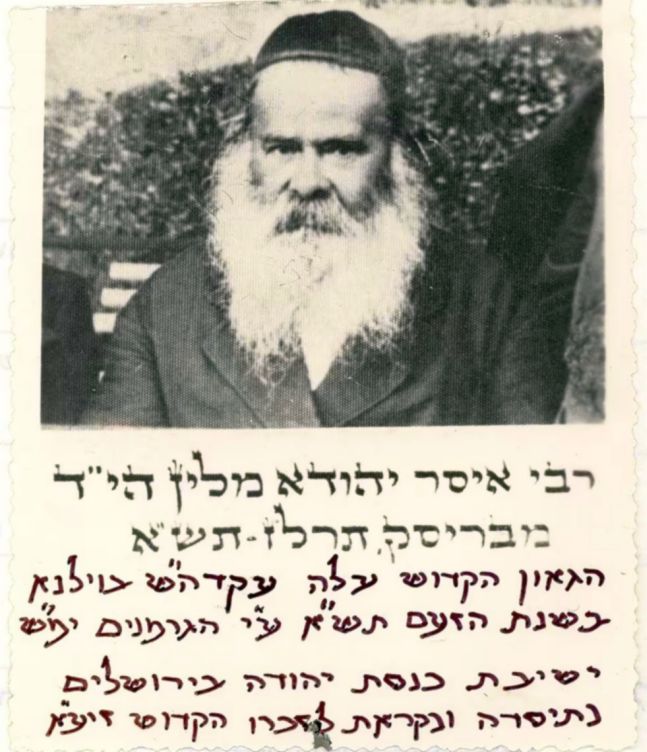
HaRav Isser Yehudah Malin zt"l
Part I
This hesped was originally written and published in 1994.
For Part II of this series click here.
Dr. Gottesman, the cardiologist: "Do you realize that during the
past two weeks you have suffered two heart attacks, and both
times you almost went off to Olam Haboh?
Rav Malin: "Yes, I do, and I know that you ordered strict bed
rest. Nevertheless, I still want to go out to daven Minchah-
Ma'ariv."
G: "Well—all right, you can go."
M: "I also need to go and learn Torah afterwards in the Kollel."
G: "Hmm... I can permit you to do that, too."
M: "And, Doctor, I must fly to chutz la'aretz to
collect donations for my Torah institutions!"
G: "Rav Malin! ... Oh all right, I will let you do that also."
HaRav Meir Malin's total dedication to Torah was realized by all;
his own bodily health was governed by it. This dedication
manifested itself in his dauntless fight for Torah ideals, not
only in Eretz Yisroel but on three continents (in Europe: Brisk
and Kaminetz; in Asia: Shanghai and Yerushalayim; in America:
Washington, DC). It was a fight that spanned his entire life,
from youth until his last breath, under all states of health and
at any possible opportunity he could seize—even during a casual
meeting.
HaRav Isser Yehuda Malin, eldest son of HaRav Meir zt'l,
once asked Dr. Gottesman how he could possibly have allowed
his father to undertake all these strenuous activities when he
usually ordered strict bed rest, after someone suffered two
severe heart attacks. Dr. Gottesman simply replied that over
years of treating HaRav Malin he saw clearly that anything
related to ruchniyus could only improve his medical
condition. "He was healthier in chutz la'aretz running
around collecting money for Torah learning than resting here in
Eretz Yisroel!"
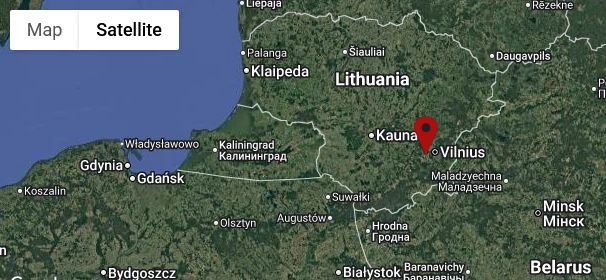
Brisk
His Background
There is a famous Yerushalmi saying, "Blood is not water"—a
person's lineage goes far to determine what he will be. In HaRav
Malin's case, complete commitment to strengthening Torah was
certainly deeply-rooted in his blood.
His grandfather, HaRav Isser Yehuda Malin, was descended from the
Tosafos Yom Tov. He served as the av beis din of Brisk, and
was known for his unbelievable diligence in Torah learning, as
well as his personal courage: he never backed down once he had
ruled in a din Torah.
His son, HaRav Yosef Shraga, was av beis din in Brisk after
his father. Once when he was out of town, a dayan arranged
a get. Upon returning R' Yosef Shraga found halachic doubts
about its validity.
When HaRav Chaim Soloveitchik was asked for his opinion, he
refused to express one, advising that the world's most eminent
poseik, HaRav Yitzchok Elchonon, be approached for a
decision. However, he added, R' Yitzchok Elchonon should be asked
to reply only with a short psak by telegraph, without
citing his reasoning—because if he did cite it, R' Yosef Shraga
would probably refute it!
HaRav Isser Yehuda, the son of HaRav Yosef Shraga and father of
HaRav Meir Malin, was first the rav of Lomzha; at the age of only
thirty, he took over from his late father as av beis din in
Brisk.
Until then, there was only one kollel in all of Europe: the
Kovno Kollel in Slobodka. Though the idea was still novel and
unconventional, in 1922 HaRav Isser Yehuda established Yeshivas
Or Torah, the first kollel in Brisk.
Not only did he promote Torah learning, besides heading the
Brisker beis din, but he also strengthened Shabbos
observance with mesiras nefesh. On erev Shabbos, R'
Isser Yehuda would walk through Brisk's commercial center to make
sure that the shops closed before Shabbos. If any store remained
stubbornly open, he simply sat down in front of the store.
Obviously, no one would dare enter the store where the
tzaddik HaRav Isser Yehuda was sitting.
HaRav Meir Malin's Chinuch
HaRav Meir Malin was born to this family of dedicated bnei
Torah on Friday, 19 Av, 5673 (August 22, 1913). He learned in
the famous Brisker cheder and excelled in his studies. When
he was eleven years old his father arranged for a young scholar
to learn gemora Beitzah with him after cheder hours.
This tutorship did not last long.
After merely receiving initial guidance, R' Meir managed
perfectly well to find his own way through the intricacies of the
gemora. In fact, at the age of fourteen he wrote and
published his own novellae on the Shas, called Or
Le'Arbaah Asar—`The Eve of the Fourteenth', which could also
be understood as `Light For The Fourteen-Year-Old.'
His youthful age did not inhibit his strong, decisive will. One
Shavuos morning when he was twelve years old, R' Meir marched
proud and erect to the house of HaRav Moshe Sokolovsky (the
author of the Imrei Moshe) for kiddush, together with
the older bochurim. After seeing his intrepid bearing,
Rebbetzin Sokolovsky remarked, "He is a kleineh
sodolchikel" (a little soldier). Indeed, he was already then a
soldier in Hashem's army, and in the future would become one of
His most courageous generals.
In Brisk he always wore a long tallis koton over his
clothing, and walked with it along the streets of Brisk,
oblivious to the stares of non-Jews. When older he was
influential in persuading Jews to observe Shabbos in his home
town.
R' Meir was educated in some of the elite Torah academies of
Europe. When only twelve and a half he was studying in HaRav
Moshe Sokolovsky's yeshiva. Later he spent two zemanim at
R' Elchonon Wassermann's yeshiva in Baranovitch, and in his
fifteenth year he commenced his studies at the renowned Kaminetz
Yeshiva, where he stayed for nine years, studying under R' Boruch
Ber Lebovitz.
R' Boruch Ber cherished R' Meir and was accustomed to take long
nighttime walks with him, during which R' Boruch Ber would guide
him along the paths of an unswerving Torah outlook. He never
forgot his Rebbe's blazing yiras shomayim, and the wealth
of stories he heard from him about gedolei Yisroel aroused
within him an ardent will to emulate them. Without a doubt, R'
Boruch Ber was grooming his disciple for his future path in life.
The Kaminetz Yeshiva was housed in a shul, most of whose
members were laymen allied with Mizrachi circles. Once, during a
celebration sponsored by the Mizrachi party, Hatikvah was
scheduled to be sung. The shul's president ordered the
yeshiva bochurim to stand in honor of the Zionist anthem.
R' Meir was not quiet and he spoke out forcefully and chided the
president. The congregants were on the point of taking action
against him for his insolence, and the president, too, announced
that since the baalei batim were supporting the bochurim
they should listen to them.
R' Meir answered sharply, "The truth is just the opposite: it is
the bochurim who support the baalei batim! For the
sake of the yeshiva bochurim they are given their
livelihood, and only because they learn in the shul is
there food in Kaminetz."
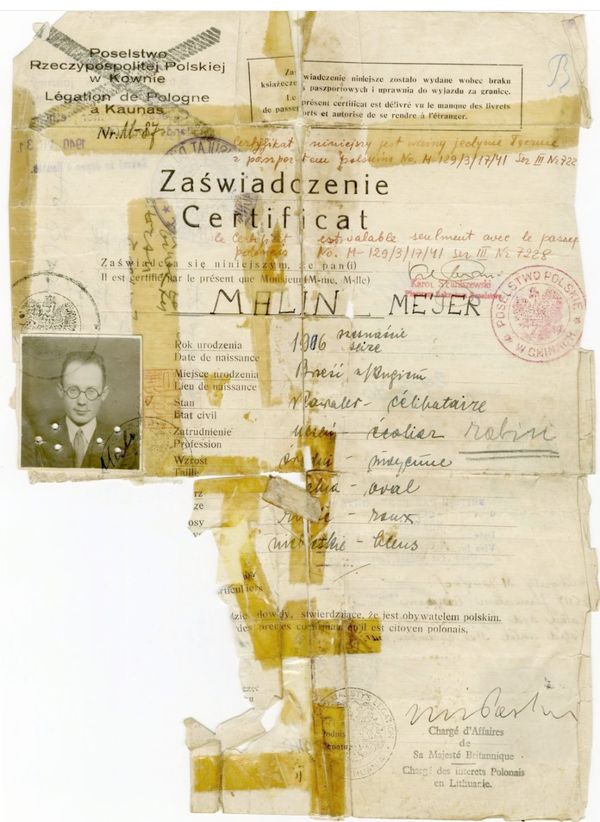
HaRav Malin's Sugihara-issued Visa
World War II
On September 1, 1939 (5799), Germany attacked Poland and World
War II began. The Kaminetz Yeshiva moved to Vilna for the war's
first year.
Although endless attempts were made by the Vaad Ha-hatzalah to
secure visas for R' Meir's father, they arrived too late. HaRav
Isser Yehuda and his son Chaim Simchah were killed during a Nazi
Akzion in Vilna (9 Av—12 Av, 5701/1941). Another son,
Yosef Shraga, was beaten so badly by a Lithuanian goy that he
died soon after. The widow and daughters Chaya and Esther, were
killed by the Nazis in Grodno. In Brisk, his daughter Miriam, her
husband, and their three children were murdered. R' Meir and his
brother R' Nechemiah were the only survivors.
In 1941 the students made the three-week-long train journey
across Russia, and after a further three days on a boat (mostly
used for transporting animals) they reached the Japanese port of
Tsugaru. When they arrived in Kobe they had been issued no more
than a ten day tourist's visa!
Much to the credit of the Jewish community of Japan, their
support made life there bearable for the refugees. Those students
of the Kaminetz Yeshiva who arrived at Kobe were placed in
refugee homes and joined the Mir Yeshiva, headed by HaRav Chaim
Shmuelevitz and R' Yechezkel Levenstein, which was then learning
in a makeshift beis medrash in Kobe.
The Japanese, who were allies of Germany, did not long tolerate
the Jewish presence in Kobe. After eight months, the refugees
were labelled "persona non grata" and shipped off to the
International Quarter of the free city of Shanghai.
Life In Shanghai
About twenty thousand Jewish refugees lived in Shanghai between
the years 1941 and 1946. Many of these Jews set up businesses and
a framework of communal life, including a local newspaper. [It is
a pity that this epoch of Jewish history has not been thoroughly
documented. Many documents that were shown to me have yellowed
with age and are crumbling. Soon it will be no longer possible to
perpetuate this unique period.]
The refugees were mostly non-religious; only a mere 20% were
shomrei Torah. Before the influx, the community was one of
assimilated Jews, both Sephardic and Ashkenazic, from the times
of World War I.
Once when R' Meir entered a synagogue on Shabbos, to his utter
dismay music was being played before krias HaTorah! Despite
the gabbai's attempts to stop him, R' Meir got up to the
bimah and protested this shocking disgrace of the Torah.
"How can one read the Torah in a place where what is written
therein is desecrated?" he asked.
That night the gabbai had a dream rebuking him for the
shocking chilul Shabbos he had condoned, and the
congregants decided from then on to run the shul according
to Torah law. Another victory for R' Meir!
The Machzikei Hadas Organization set up a branch in Shanghai, in
which HaRav Malin served as general secretary, while HaRav
Ashkenazi (the local Rav) and the Amshenover Rebbe ran it. This
organization aimed to strengthen Shabbos observance, Jewish
education, Torah study, taharas hamishpocha, kashrus, and
other basic mitzvos. They hung up posters publicizing
Shabbos candlelighting times, they baked matzos, established a
kosher meat factory, organized public fasts, opened a kosher
restaurant, and held droshos for the masses. Due to the
work of Machzikei Hadas, two-hundred-and-fifty Jewish stores
signed a pledge to be closed on Shabbos.
The gabboim of one of Shanghai's shuls came with a
sheila to R' Meir: "The shamash handed his children
over for adoption to a French Catholic missionary. May he still
continue serving as shamash?"
R' Meir shouted passionately, "You are asking if he can
continue in his position? How can you be allowed any more
to enter a shul, after you have allowed a Jew to reach such
a depth of poverty and despair that he would bring his children
to a missionary? That is my question!"
R' Meir immediately went to talk to the shamash himself,
who sighed and told the Rav that he had no choice left in the
matter. His wife had died. A couple had agreed to adopt the
youngest children, but the older of his eight children were
starving, and he had no means of supporting them. R' Meir
immediately pledged to take full responsibility for their
support, including seeing that they would be adopted by observant
families. But the shamash was a broken man, devastated by
poverty and grief; he could only repeat dully that he had already
handed the children over to the missionary; it was too late.
"Too late" and "too difficult" were words that meant less than
nothing to R' Meir. "Where there's a will there's a way" was his
motto. Calling two other bochurim (R' Mordechai Schwab and
R' Hillel Mannes) to join him, they made their way to the
convent, laden with goodies. While the other two talked to the
antagonistic missionary officials, R' Meir stole his way in and
located the shamash's children. He spirited them out of the
mission house and rushed them over to the Jewish neighborhood,
where he hid them with widely scattered families.
It took time for the children to learn not to cross themselves
each night before bed, as they had been trained to do by the
missionaries. But these same children went on to establish
splendid Jewish families in Eretz Yisroel—all with the merit of
the dauntless R' Meir.
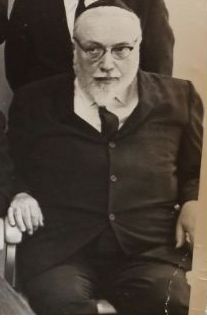
HaRav Arthur Bogner zt"l
On The Shores Of America
After the war the Vaad Hatzala arranged a visa for R' Meir Malin,
and Yeshivas R' Yitzchok Elchonon provided documents for a
student's visa for his brother R' Nechemiah. The Malin brothers
sailed on the San Maria and reached America in 1946. Like
the bochurim of the Mir Yeshiva, they first docked at the
port of San Francisco.
In San Francisco, the elderly Rav Katzman asked them to stay and
open a yeshiva. They, however, decided to move on to Chicago and
meet their uncle, Rav Yehuda Leib Kagan, then rosh yeshiva in
Beis Medrash LeTorah in Chicago and later in Yeshivas R' Yaakov
Yosef in Brooklyn. Their travels did not end there. The brothers
continued on to Pittsburgh, where Rabbi Yosef Shapira, the rav of
the Poalei Tzedek shul, offered them his shul in which to
establish a yeshiva.
A local Pittsburgh newspaper at the time described HaRav Meir
Malin as a "youthful, energetic, well educated man with a
mission." He was quoted as having said, "The only explanation I
can give as to why my life and that of my brother have been
spared is that we were fated to establish a living monument to
the millions of fellow Jews whose fate was to die in misery."
The living monument he wanted to build was the Brisker Yeshiva,
which he set out to reestablish in Pittsburgh. That dream,
unfortunately, did not materialize. At that time bochurim
were not used to going "out-of-town" to learn in yeshivos, and
therefore not enough talmidim could be gathered in
Pittsburgh. The yeshiva closed after only one month.
In 1947 the brothers traveled on to New York. R' Moshe Feinstein
and R' Reuven Grozovsky praised them profusely and offered to
help them in America.
At first they learned in the Mir Yeshiva. Later R' Meir was
appointed rav of the Pinsker shul on Riverdale Avenue in
Brownsville (which at that time was called "the Yerushalayim of
America"). In that same year, 1947, R' Meir married Yocheved
Aharonson, the daughter of Rav Yosef Zvi Aharonson, rav of New
Britain, Connecticut, whose interests reached all the way to
Baltimore. His brother, R' Nechemiah, married the daughter of Rav
Arthur Bogner, who was a rav in Washington.
The Brisker Yeshiva — Or Torah, one of the first out-of-town
yeshivas in America, was established in Washington, D.C. in 1951
by the Malins, and lasted fifteen years. Although Washington was
the capital of the U.S.A., as far as Yiddishkeit is
concerned it was, at that time, almost a barren desert.
R' Meir took bochurim from secularized, even anti-
religious, families and turned their lives and that of their
families upside down. He poured out his warm Jewish heart for his
talmidim; and since "all hearts speak the same language,"
as the saying goes, they became as close to him as sons are to a
father.
Parents who had intended their sons to become lawyers, doctors,
or other white-collar professionals, begged the boys to return
home to their loving families. The bochurim refused; they
had found the derech HaTorah and were unwilling to leave
it. In fact, many of the parents themselves became religious
thanks to the Brisker Yeshiva. These same bochurim were
later sent by the Malins to Lakewood and Baltimore, and have
since become true bnei Torah and talmidei chachomim,
founders of Torah-true homes.
End of Part 1
|