| | Feature
Ten (40) Years Since Reb Moshe's Petiroh: Facets of His Thought and Deeds
Extracts From Igros Moshe Collected by Shalom Meir

For Part II of this series click here.
For Part IV of this series click here.
Part 3
They Know of No One to Turn to But Me
Although it is not for me to give a definitive ruling in a matter which is subject to a difference of opinion between Rishonim, there are nonetheless instances where it is impossible to follow a course which encompasses all the differing opinions. In such cases, one is compelled to issue rulings to those who come to ask and they know of nowhere else to turn but to me...
I am therefore forced to render a clear decision, that I can teach to those who ask to know my humble opinion as to what appears to be correct. Not only is it permitted for the wise men of the generation to issue practical rulings of this nature, they are obliged to do so, ruling according to the conclusions they reach after much toil and labor in clarifying the halacha from the gemora until the works of the poskim, according to their capabilities, earnestly and with the fear of Heaven. (Orach Chaim IV:12)
No Mistakes In Klal Yisroel's Practice
I am prefacing my reply with an important general principle. By calling something practiced by all of Klal Yisroel a mistake, your honor is presuming himself to be greater than all of our teachers, the Rishonim and Acharonim, and all the great scholars of our own generation as well. You consider all of them to have been mistaken, whereas you alone have spotted the mistake.
May your honor forgive me, but just to entertain this idea betrays excessive pride, let alone to utter it and write it down. Your honor should be aware that any practice that we find a large community observing, is no mistake. Since the community consists of observant Jews, we can assume that the practice was surely instituted under the guidance of a Torah scholar. It is therefore incumbent upon us to seek a reason for it, rather than simply to imagine them to be mistaken, just because this is not the practice in other communities. Such a practice is not followed when one is on one's own however, because it nevertheless remains the practice of just one community. Every matter should be considered on its own merits.
When however, a practice is followed by all of Klal Yisroel, halacha obliges the individual to follow it, even if he thinks it is a mistake. One ought to know that Klal Yisroel as a whole acts correctly. Even though you may have some difficulty which you do not know how to resolve, it is nothing. (Orach Chaim IV:17)
Joining Other Observant Jews
It is a great mitzva to befriend observant Jews, as the posuk in Tehillim states, "I am a friend of all who fear You." Here we see that there is an obligation, that has been passed down verbally, to attach oneself to Torah observers. At the beginning of the sixth perek of Hilchos Dei'os, the Rambam writes that man was made in such a way that he is drawn after the opinions and actions of his comrades and friends and that a person should therefore associate with righteous individuals and keep his distance from evildoers.
One should not think that this only applies to the wisest and best people, for since the Rambam writes that one should associate with righteous people and keep a distance from evildoers, citing the two extremes, it is evident that all whose level is intermediate between these two are enjoined to attach themselves to those from whom good things can best be learned, and to keep away from those from whom bad things can chas vesholom be learned, even if they are not actual evildoers. (Orach Chaim IV:33)
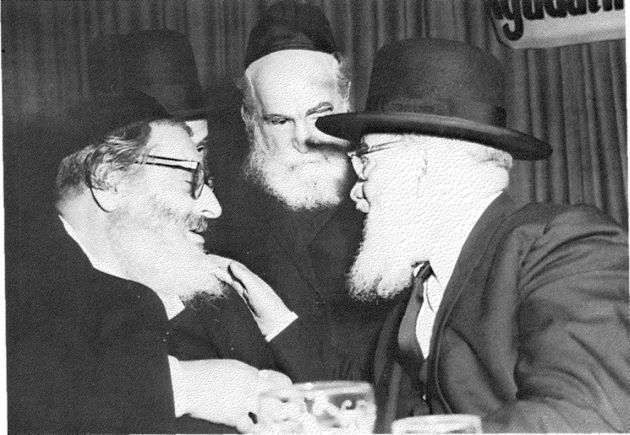
HaRav Yitzchok Hutner, HaRav Moshe Feinstein, HaRav Yakov Ruderman
Consult the Eida and the Sephardim
To me it is clear that the course that should be followed in practice is as I have written. As to actually adopting it, speak to other great poskim in Eretz Yisroel, and some of the great roshei yeshiva and also with the great Torah scholars and halachic experts of the Eida HaChareidis and the Sephardim. (Orach Chaim IV:40)
For Prayers and Blessings there are G-d Fearing Men — What is my Standing in these Areas?
It is my custom only to write replies concerning Torah matters with which somebody is having difficulties, to which he feels that I, in Hashem's kindness, can respond. Here, I am obliged to reply with my opinion and to clarify matters for the questioner. When it comes to prayer and a blessing for someone who is sick, there are many G-d fearing men in Eretz Yisroel whose prayers are certainly accepted by Hashem Yisborach. What is my standing in these areas? (Orach Chaim IV:47)
It is Not My Practice to Study Periodicals — If Only there was Enough Time to Learn Everything!
It is not my practice to study periodicals. If only my time sufficed for learning and studying the writings of our teachers the Rishonim and Acharonim, from whose words we live! If therefore, I would have known that such a serious matter... had been discussed in a periodical, which is tantamount to discussing it before thousands, including ordinary folk and those who are far from the fear of Hashem and the fear of sin, who are just looking for the shadow of a heter with which to fool themselves... (Even HaEzer 64)
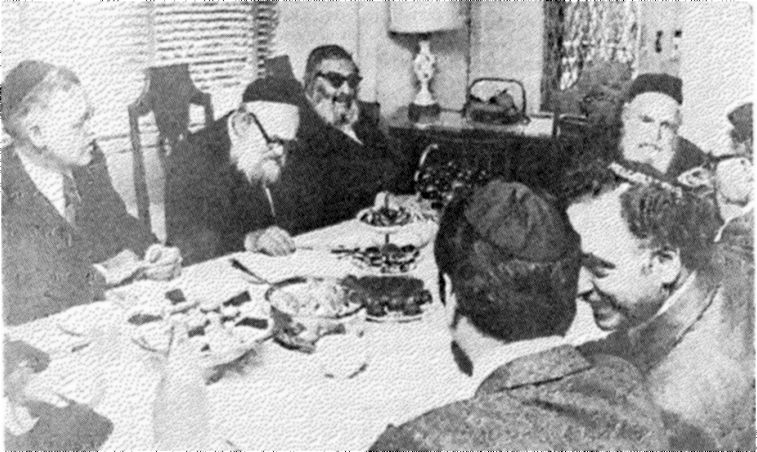
Rabbi Moshe Sherer, HaRav Yaakov Kamenetsky, HaRav Yitzchok Hutner, HaRav Moshe Feinstein at a meeting with Israeli Prime Minister Begin
Anguish and Sorrow Make it Impossible to Reply
The strangest of questions which, in our sins, result from the dreadful decrees that are in force in the hospitals in Eretz Yisroel concerning autopsies that are carried out by the lawless and wicked members of our people are extremely difficult to solve because it is impossible to think calmly and peacefully on account of the anguish and sorrow that they evoke. Nevertheless, I will try to write down some practical considerations concerning the situation because of the pressing need for immediate information, and may Hashem Yisborach help me... (Yore Deah III:150)
It is Difficult to Answer on Two Accounts
As to what your honor wrote about the law of the land, it is difficult to write about these things for two reasons. First, because of what is written in Sh"UT Heishiv Moshe, that great confusion exists among the poskim with many contradictions, requiring much time and study — then maybe Hashem will help us to understand and to arrive at conclusions that can be applied in practical halacha — how much more so does this hold true for those of puny worth, like ourselves?
The second reason is that we ought not to chas vesholom appear to be lessening the honor of the Government of this country... (Choshen Mishpot 72)
Proofs Should Not be Adduced from Newly Published Works
Nowhere amongst the Rishonim do we find anyone who explicitly disagrees with the Rambam. It is true that the Tosafos HaRosh in the Brocho Meshuleshes writes against him but this changes nothing as far as the halacha goes since it is not brought that the Rosh argues with the Rambam. Generally, proofs should not be brought from seforim which the Rishonim did not see, when these [proofs come to] contradict things that are clearly stated, because some mistake may have found its way there. Perhaps only the question is brought and the answer is missing. (Orach Chaim II:20, at the end)
In our Many Sins, the Ability to Give Counsel has been Removed from Us
As to your honor's question, even though it is only a matter of giving advice, in our many sins, this ability has been taken away from us until Hashem Yisborach has mercy and returns our counselors as formerly, for which we pray and hope continually. Nevertheless, I will try to say from Chazal's words, what appears to be correct... (Orach Chaim IV:48)
Lower East Side Public Housing like where HaRav Moshe Feinstein Lived

When Should a Talmid Chacham be as Unyielding as Iron and When Should He Concede
My friend has asked a question on Rabbenu Gershom's commentary to Taanis 4, concerning Rav Ashi's statement, "Any talmid chochom who is not as hard as iron, is no talmid chochom," on which Rabbenu Gershom comments that "not as hard as iron," means that he is not difficult to appease. This seems to be contradicted by what the mishna says in Avos (perek 5:11) that a chossid is someone who is hard to be angered and easy to appease.
The correct explanation, in my humble opinion, is that the two sources are referring to two separate things. In Taanis, the gemora is talking about being unyielding in standing up for one's opinion, when this is what one holds to be the truth according to the din and the halacha. If in such a case, if the chochom became angry with people who did not want to act in accordance with his opinion, then if they see that he is easily appeased, rather than attributing this to his fine character, they will say that it is because he ought not to have become angry in the first place, because he knows deep down that the truth is not with him and he just doesn't want to admit his mistake. A source of error will thus arise, both in connection with this matter and others, where people will not pay attention to his rulings because they will say that he isn't a talmid chochom that one can rely upon...
The mishna in Avos is talking about anger over something improper that was done, of whose evil nature both the general public and the perpetrator are well aware. In this case, if the talmid chochom is easily appeased, nobody will err in thinking that he regrets his anger. Rather, they will understand that it stems from his good traits and from the fact that he wants to behave good naturedly and peacefully with others.
In his commentary on Avos, Rabbenu Yonah points out that the mishna does not say that one should never become angry. Sometimes one does have to grow angry, to defend Hashem's honor, like Pinchos. For this reason, he explains, the mishna says he should be `hard to anger,' i.e. he should become angry but this should only be with difficulty, on those occasions when one may not remain even tempered.
It is also good to be appeased immediately, continues Rabbenu Yonah, while the anger is still upon him i.e. not after he has calmed down rather, while still at the height of his anger, he should be easily pacified, for this is a trait of piety and good heartedness.
According to this, Ravina's concluding statement in Taanis is readily understood: "Even so, a person should train himself in gentleness, as it says, `Remove anger from your heart.'" It does not appear that Ravina intended to dispute what Rav Ashi said. Since Rav Ashi was speaking about anger whose purpose is to lead others on the correct path when they would not have recognized it by themselves, then once he has become angry, he should certainly not be appeased easily, for the reason that I explained. However, to begin with, one should train oneself in gentleness and seek alternative ways to instruct others and lead them gently, as the posuk says, `Remove anger from your heart.'
This is the advice Koheles gives to talmidei chachomim. Even when their anger serves a purpose, they should seek ways to remove it and look for other ways to lead the people gently, for if they employ anger to do so, they will not be able to do away with it immediately and people may thus gain the mistaken impression that it this trait has become engraved upon their leader's heart. If his anger was on Hashem's behalf, over some well known breach, like in the case of Pinchos — then his protest needs to be made with anger, in order to show that one must become excited over Hashem's honor. (Orach Chaim I:54)
People are Allowed to Take Issue With Me — Apologies are Superfluous
Your honor's apology for arguing with me over an halachic issue is superfluous. This is Torah's way. The truth must be clarified. Chas vesholom that anyone who doesn't agree should remain silent, whether his conclusions are more lenient or stricter.
As to the posuk which warns us, `You shall not answer a rav,' see the Nimukei Yosef... who explains that what the posuk means is that it is correct to act in such a way that it will not be necessary to answer against a rav. It is also logical to say that nowadays, nobody exists who is great enough in regard to applying this injunction to him. Therefore, even if your honor feels that I am a great man, he is allowed to disagree with me and consequently, is obliged to state his opinion and there is no need to apologize. At any rate, as regards the actual question, the truth is as I have stated... (Orach Chaim I:109)
I Don't Even Have a Small Amount of Free Time
I don't even have a small amount of free time, for I must reply to those who ask for practical guidance. Nevertheless, since your honor has raised many difficulties, my words appearing baffling and seeming to contradict what is written explicitly, I am compelled to reply. May Hashem Yisborach help me to make matters clear. (Yore Deah cheilek II, siman 50)
No Notice Should be Taken of A Custom that Goes Against the Gemora and the Poskim
As to the practice which is customary in some places... it is a mistaken custom and it is forbidden to practice it... this should be done everywhere and no attention should be paid to a custom which goes against the law which appears clearly in the gemora and the works of the poskim. Even if they say that a great man instituted it, they must change their practice and act in accordance with the din. (Orach Chaim II:35)
All my Ideas Stem from my Torah Knowledge, without Any Taint of Other Disciplines
I received your very lengthy letter, overflowing with words of rebuke for what seemed to you... incorrect in my responses. From what you write, it is apparent that you think I will take exception to your words of castigation. However, the reverse is true — I am moved to see that there are men of spirit who are neither afraid nor ashamed to utter words of rebuke.
The truth is that there is nothing more in what I wrote than Torah truths, as they appear in the writings of our teachers the Rishonim. Your honor's protest arises out of an approach which develops from the knowledge of ideas which belong to disciplines outside the Torah. These ideas imperceptibly influence even men of great wisdom, causing them to understand the mitzvos of Hashem Yisborach in the holy Torah, in the light of those fallacious ideas. The result of this is, chas vesholom, that what is permitted takes the place of what is forbidden and vice versa.
This is tantamount to interpreting the Torah in a way different to the halacha, which is regarded in the most serious light, even when it results in greater stringency. This is well known from those places where the practices of the Tzidukim were stricter and Chazal consequently made lenient enactments to clearly demonstrate that the Tzidukim were erring. Boruch Hashem, I am neither one of them nor one of those who flock after them. All my ideas stem purely from my Torah knowledge, without any taint of external disciplines.
The Torahs's laws are true, whether they are lenient or stringent. Rationales whose sources lie in other systems and in ideas that spring from an empty heart are worthless, even if they result in stringency and an imagined heightening of holiness and purity. (Even HaEzer II:11)
End of Part 3
|