| | Feature
Reb Menachem Mendel Beilis: Because He Was Jewish
by Binyomin Nehorai
Reb Menachem Mendel Beilis with his family in 1910

To remind us that antisemitism is nothing new. This was first published thirty years ago, in 1996.
Ivanov, a detective in Kiev's police department, stood at the opening of a cave at the outskirts of the city. Little did he know that a new antisemitic volcano, capable of putting an entire nation on trial, was about to erupt. His thoughts were focused in another direction.
The clues led to a known family in Kiev — to the apartment of the notorious Vera Cheberiak, a key figure in Kiev's underworld.
The district attorney of Kiev knew that the conclusions of Ivanov's investigation had been presented to Chaplinski, along with a request to arrest Vera Cheberiak.
However, the request, so it seems, was rejected, and for a good reason, too. Ivanov was employed by Kiev's police department, while Chaplinski was a government worker, a representative of the Czar. In government circles, the murder was regarded from a different angle.
Like the marksman who drew the circle after his arrow had landed, so had the authorities earmarked their victim — the Jews — long before the trial had begun. All that remained was to prove that the Jews were guilty. That was their plan!
The affair began with the discovery of a young boy's body. Ivanov went to the scene of the crime. It was the 20th of March, 1911.
The hands of the boy found in the cave were bound. Scores of gashes mutilated his body. Later on, this amount was reduced to thirteen, a number with connotations in the Jewish faith.
Later on, too, the full account of the murder was retold. The victim, Andrei Yuschinsky, was the best friend of Zenia, Vera Cheberiak's son. On the day of the murder, Shabbos, the 12th of March, Andrei went to school. On his way, he decided to veer from his regular course and to stop off at Zenia's home. As they were playing, an argument broke out between the two. "I'll tell the teacher that you ran away from school," Zenia threatened.
"And I'll tell them that your mother is hiding stolen goods in your house," Andrei retorted.
Zenia ran to his mother and told her about the argument. Vera drew quick conclusions: "Andrei, my son's best friend knows too much. That's not good."
She invited Andrei inside, where a few members of her gang awaited him. That was the last time he was seen alive. Two days later, Andrei's mother filed a complaint in the police department. A week later, Andrei's stabbed body was found in a cave.
According to official announcements, the murderer wasn't located. However, the Czarist National Parliament solved the murder through a parliamentary question presented by one of its representatives: "Is the government at all aware of the fact that ritual murders are perpetrated in Kiev, and that Andrei was murdered for religious purposes?"
The parliamentary hint — and one or two from the royal palace — were sufficient. The district attorney of Kiev understood. He received a boost, after a brief glance at the Jewish calendar told him that it was almost Pesach.
The funeral of the youth rapidly developed into an enraged protest rally against the Jews. The chief instigators demanded that the "criminal group which encourages its sons to perpetrate murders" be punished. One of the leaflets, circulated throughout Russia on the day of the funeral, read: "The Jews tortured Andrei Cheberiak. Every year on the eve of the Pesach holiday, they torment Christian children in order to secure blood for matzo dough. They do this to commemorate the torture they suffered at the hands of Christian Russians. If your children are dear to you, kill the Jews... Avenge the blood of the saintly and tormented child..."
The mob got what it wanted. At first, a medical opinion on the cause of the death was issued. Two doctors "determined" that blood had been drained from the body. These learned men said that the blood had apparently been let while the victim was still alive.
After the doctor's opinion was heard, a psychiatrist's opinion was sought. The report of Professor Sikorski stated that "the psychological foundations for such types of murders are the racial hatred and the feelings of vengeance harbored by the sons of Jacob against members of other faiths."
The arrow was shot and landed. Now the target had to be encircled. According to the testimony of one of the members of the "Black Hundred," a fanatic, antisemitic reactionary group — the murderer was Mendel Beilis, a clerk in the brick kiln of a Jew named Zaitsev. This factory was near the cave where the body was found.
The testimony of the elderly lamp lighter who had "seen" Beilis running after Yuschinsky and Cheberiak in the vicinity of the kiln, was also heard.
Beilis, a Jew of 39, father of five children, was arrested. A short while later, Zenia died. Not long afterward, so did his sister. The medical opinion presented to the court determined that the two had died of dysentery. It was issued by the very same doctors who had expressed their opinion on the factors surrounding the boy Andrei Yuschinsky's death.
Reb Menachem Mendel Beilis
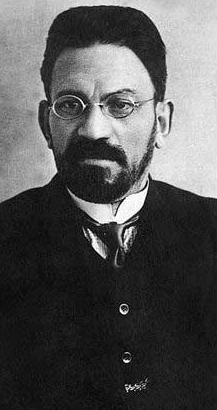
In Prison
Beilis languished in prison for two years. Outside the prison, spirits soared. Much effort was made to corroborate the allegations against Beilis. The murder of the Prime Minister of Nicholas the Second, Stolofin, who had been killed by a Jewish assassin outside of Kiev's opera house, greased the wheels of the investigation.
With the scant information and evidence which had accumulated, the authorities weren't particularly eager to begin the trial, and tried to postpone it to a later date when the "evidence would be more tightly sewn together." In a letter to the Minister of Justice I.G. Shcheglovitov, Makalov, the Minister of the Interior, wrote: "The expected acquittal will have an adverse influence on the Russian populace and will create a victory mood among the Jews."
In the wake of the statements extracted by a journalist from Vera Cheberiak, the Minster of Justice instructed the police to conduct a new investigation against her. Of course, the suspicions were "found" to be groundless, and she was freed.
After the Communist Revolution, when the defense attorney Grusenberg was invited to examine the secret files of the police department's archives, it became known that the Ministry of Justice had combed Russia for a Proslavic priest who specialized in Jewish ritual to give testimony about Pesach. However no such person could be located among the Russian clergy. It is interesting that Christian clerics and theologians publicly protested the false blood libel.
The trial commenced on October 8, 1913 (5764), between Rosh Hashana and Yom Kippur. No members of the intelligentsia were on the jury. From Petersburg, the government dispatched the chief prosecutor, A.I. Vipper, to participate in the trial. The defense was waged by the famous Jewish attorney, Oscar Grusenberg.
It is difficult to believe that such a trial took place during the 20th century, and that the questions raised throughout the proceedings were the products of the minds of learned people.
"You have the power to destroy Beilis," Grusenberg cried in his concluding speech to the jury. "But you will never be able to vilify the Jewish faith. Of what value is your verdict — you who know absolutely nothing about our religion — if you determine that Jews are not reviled by the use of human blood?"
After five weeks, during which the Jewish faith was dissected by a nation which had produced the Cantonists, the crucial moment arrived. In the light of the facts and evidence presented, the jury had no choice but to acquit Beilis.
Mendel Beilis was freed after thirty-three months of torture. He at first moved to Eretz Yisroel and established his home in Tel Aviv, not far from the streets which now bear the names of his defenders; Grusenberg and Rav Mazeh. Later on, Beilis moved to the United States, and died there.
A modern blood libel, which some of the older people among us still recall.
Reb Menachem Mendel Beilis grave in America
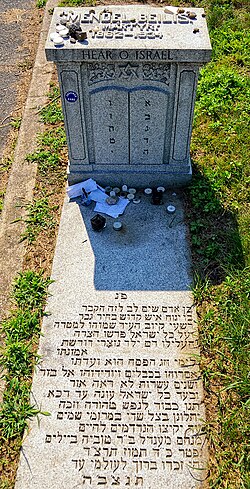
His Cries
Reb Mendel Beilis was the scapegoat for all of Klal Yisroel during the years 5661-63. The swords held over his head while he was in prison threatened not only him, but the entire Jewish Nation.
Klal Yisroel, in its entirety, at that time, sat on the bench of the accused, and trembled in fear — the fear of death. Had Reb Mendel Beilis, chas vesholom, lost the case, pogroms might have erupted throughout Russia's vast expanse.
Even though he was acquitted and released from prison, the atmosphere in Russia at that time was so rabid and hate-filled, that he had no choice but to leave his home and surroundings. Circumstances forced his family and brothers to change their names. Reb Mendel emigrated to Eretz Yisroel, and from there to America.
Even in America, he was unable to earn a livelihood and did not enjoy respect or peace of mind. [Certain businessmen offered him six thousand dollars for merely sitting beside a showcase in full view of curious onlookers, but he adamantly refused their offer.] Sadly, there is no one today, who recalls his yahrtzeit, no one to say Kaddish on the 24th of Tammuz.
True, he has descendants, and they reside in America; yet the Yisgadal veyiskadash are lacking. Doesn't anyone remember the name of the man who suffered for three years for Klal Yisroel's sake?
He is buried in the United States, in Mount Carmel Cemetery in Queens, one of the largest Jewish cemeteries in the U.S. When the "greatest" person in olam haba requires a small favor from the most insignificant one in olam hazeh, he becomes a dependent. Reb Mendel Beilis is surely pleading with us to recall him, to visit his grave, the grave of the klal's sacrifice, the grave of the "Iyov of his generation."
Don't forget. Remember and don't forget!
An antisemitic flier from those days
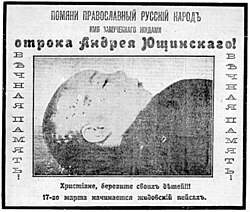
* * *
During the years 5761-63, klal Yisroel and especially Russian Jewry, was gripped by fear. Even infants in their cribs trembled and quaked.
During a period of approximately 33 months, Reb Menachem Mendel ben Tuvia languished in a prison cell, fearing the death sentence and suffering degradation and torture. Worst of all were the five weeks during which his trial took place. On every one of those days, armed guards would take him to the courthouse in a black carriage.
Jew-haters the world over, and especially those in Russia, delighted at his suffering for three years. Throughout the duration of his imprisonment, they sucked the blood of the Jews and disgraced them, venting most of their anger on the sacrificial lamb, Reb Menachem Mendel who was tortured more than anyone else. They sucked his blood and used it as ink for their newspapers and journals.
They injected the poisonous bacteria of antisemitism into their veins, and incited the shadowy lusts of the incited mob. They aroused the animal instincts in man, and all of the beasts in the world lent their hand to this effort, spilling Jewish blood in the written media.
Jew-haters dined on Jewish blood for breakfast, lunch and supper. And from meal to meal, they would become inebriated with victory, celebrating their vanquishing of the Jewish Nation. Their hunger was subdued and they felt sated only when the press carried antisemitic pictures and new antisemitic slogans condemning the public sacrifice — the shliach tsibur of Klal Yisroel, hand-picked by Hashgacha to be the Iyov of his time, the scapegoat of his generation.
Jew-haters and the masses also lived in morbid fear during those three years. Daily, the press fed them lies, telling them that the Jews were cruel murderers, Rachmono litzlan: The Jews slaughter Christian children, they said, and use their blood to fulfill the mitzvah of Afikoman. Why, the most reliable proof is staring you in the eyes — black on white! The despicable criminal who murdered the boy, left fingerprints: thirteen gashes! (Though later it was determined that there were fourteen gashes.)
If Jews managed to survive during that period, it was only due to a miracle and as a result of Hashem's mercies. The clergy and the government officials joined forces, adding fuel to the fire. They preached: Look at the Jews, their rabbis, their teachers, their Talmud. See what they are, who they are! In that manner, they plied them with all the antisemitic propaganda in existence since time immemorial, stoking the fire with kerosene, and aided by an antagonistic press replete with venomous articles and antisemitic pictures.
The press, whose purpose was to influence public opinion, would conduct daily brainwashing ceremonies, stressing and reiterating the guilt of Reb Mendel Beilis, deluding the masses into believing that Reb Mendel Beilis was a murderer, doomed to death. On every occasion, they added that not only he, but the entire Jewish Nation, Rachmono litzlan, were criminals.
Klal Yisroel, at that time, was on trial in Kiev's court. Israel's enemies incited the masses, crying: "Look at the numerous articles in the press, at the shocking pictures. Listen to the words of the judges: `We have seen the truth. Not in vain have Israel's enemies despised the Jewish Nation throughout history. They did not hate the Jews. They despised the crimes they committed. They were reviled by the numerous murders perpetrated by Jews who killed Christian children in order to secure blood for their matzos, their most sacred food on Pesach, as if the blood in use in the matzos constitutes the main aspect of mitzvah of Afikoman!'"
While the judges read the verdict, they held a note in their hands which contained the words "in order to fulfill the mitzvah of Afikoman." It was obvious that they could barely pronounce that phrase. From their expressions, it was evident that they were delivering a prepared eulogy, whose purpose was to temper their bestial instincts and satisfy their lusts for illicit relationships, idolatry and murder.
Pharaoh had done the same thing long before them. He murdered Jewish children in order to bathe in their blood, hoping that his leprosy might thereby be cured or his body cleansed of its sins. The representatives of the nations of the world behaved in precisely the same manner. Whenever they felt that their seats were rocking or their kingdoms weakening, they would set their dogs — in the form of the image-fashioning press — on the Jews. They would besmirch the Jews and attribute to them all of the failures and faults of their respective governments. In that manner, they would incite the masses against the Jews and divert their attention from the mistakes of the governments, insuring, thereby, their dominion forever after.
Israel's enemies have behaved in that manner throughout the generations. Beginning with Pharaoh, these enemies slaughtered and murdered with extreme cruelty, using various and strange methods, crueler than those of predatory animals. They murdered small children, smashing their heads against walls and casting them into rivers and raging flames. They starved Jews to death, disgracing and vilifying them. Then they hurled them into gas chambers.
All these shocking crimes took place a hundred fifteen years ago. This past generation witnessed those atrocious deeds and saw how Jews were led "like sheep to slaughter." In comparison with the disgraces and the sadistic methods and tricks which the Germans, in their insidious wickedness, devised, death was the easiest punishment of all.
All the fears and torments were heaped on the weak shoulders of Reb Menachem Mendel ben Reb Tuvia Beilis for three years. An observer summed him up: Mendel Beilis was "a dignified, respectful, well-liked, fairly religious family man with a faithful wife, Esther, and five children."
On the day that Reb Mendel Beilis was freed and acquitted, a verdict was issued stating that Beilis wasn't the murderer. Nonetheless, Israel's enemies remained staunch in their belief that the Jews use Christian blood in their matzo dough on Pesach.
Had Reb Mendel Beilis not left Russia immediately, he probably would have been murdered by enraged and vengeful antisemites. His brothers and family changed their last names because their lives were in danger.
Due to his great fame, Beilis could have become wealthy through commercial appearances. Spurning all such offers, he and his family left Russia for a farm purchased by Baron Rothschild in Palestine. He arrived in early 1914 with celebrity status, welcomed warmly by Jews and Palestinian Arabs alike.
Beilis had difficulty making ends meet, however, but he resisted leaving. When friends and well-wishers pleaded with him to go to America, he would respond: "Before, in Russia, when the word 'Palestine' conjured up a waste and barren land, even then I chose to come here in preference to other countries. How much more, then, would I insist on staying here, after I have come to love the land!"
He eventually moved to America but Reb Menachem Mendel died a pauper and is buried in the Mount Carmel Cemetery in Queens.
He was the public sacrifice of klal Yisroel, and the klal owes him a debt of gratitude. If, Heaven forbid, he had been convicted, not only would he have been sentenced to death, but brutal pogroms would have erupted throughout Russia. Jews would have been slaughtered; blood would have been shed, and who knows where we would be today?
The atmosphere in Europe, particularly in Russia, where most of the Jewish Nation resided, was tense, antagonistic and poisonous, as a result of the verdict and the fact the sacrificial lamb's escape to freedom. Many years after the Beilis trial, rabid antisemitism was still keenly felt. Even today, antisemites in search of prey, open their mouths, displaying sharp and menacing teeth. "Blessed is Hashem, Who has not given us a prey to their teeth."
At that time, the Jewish Nation, and especially Reb Menachem Mendel ben Reb Tuvia, underwent much suffering. He was redeemed from his plight only by his death, on the 24th of Tammuz, 5694.
All over the world, whenever a Jew entered a beis midrash to pray, the name Reb Mendel ben Beilis would be recalled. Everyone participated in his sorrow, and empathized with his suffering and pain, and with the degradation and the terrible fears which were his lot, as he was guarded by the armed soldiers who waved their swords over his head. These swords pierced the hearts of every Jew and every soul. Blood was spilled deep within them. To our dismay, we are in the golus of "let heavy work be laid upon them." We are preoccupied with eking out our livelihoods, or as the Rav of Krasna said: "We are in self imposed ghettos.
Even more preoccupied are those who pursue luxuries, because luxuries are like predatory birds who rob man of his sanity, tranquility and kedusha, for tranquility and kedusha go hand in hand. Dear Jews, you are not to blame for being so busy and preoccupied; but neither is the "sacrifice."
It seems to me that the following words constitute Reb Menachem Mendel Beilis' last will and testament: I Menachem Mendel ben Reb Tuvia plead with you: Don't forsake me. Don't forget me. I was your sacrifice — the sacrifice of the tongue offering. Therefore draw me closer to you. What I lack is a burning candle from olam hazeh so that my dark grave will be illuminated. Remember that no one can escape the dark and cold grave. Take me as an example. I was a Jew who for whose sake the entire world rallied, and now, who remembers me? I have been totally forgotten.
A new gravestone should be placed on his grave, and a monument should be erected in his honor, because the small one on his grave has rusted, and is overgrown by grass. Over the years, its inscription is liable to become effaced. Jews of European descent are required to remember and to act. On the merit of their remembering Reb Menachem Mendel ben Reb Tuvia, may we all rise up in Techiyas Hameisim and witness the coming of the Moshiach speedily in our times.
He is buried beside a great man named Reb Yosef ben HaRav HaGaon Reb Meir Feimer, who was a rabbi in the Lithuanian city of Britzer, and who died on Wednesday, Alef Rosh Chodesh Kislev 5699.
|