| | Feature
Chaim Shetehei Bonu Ahavas Torah: The 204th Yahrtzeit of Rav Chaim of Volozhin
by Rav Dov Eliach
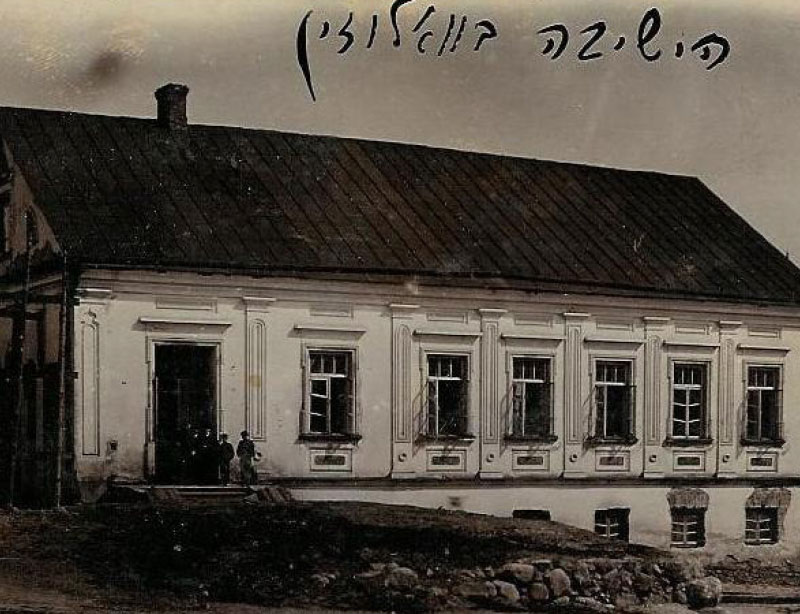
A Recent picture of the Volozhin yeshiva building

This essay first appeared in 1996, 29 years ago.
For Part II of this series click here.
Part 1
The approach of R' Chaim of Volozhin, adapted from the Hebrew book, Avi haYeshivos.
The gaon, R' Yosef Zev Soloveitchik of Brisk, once enumerated the great sages of his time. When he mentioned the Chazon Ish, he said: "Among the great students of the Gaon of Vilna, two students with totally different personalities, were outstanding. One was R' Chaim of Volozhin who, despite his great stature, was able to descend to the level of the people in order to influence them. The second, R' Menashe of Iliya — a unique person — was reclusive, and very rarely came in contact with the public. The Chazon Ish is like Rabbi Chaim of Volozhin in this respect."
Torah is Engraved On the Tablets of His Heart
R' Chaim of Volozhin was the Gra's foremost student, and is considered the greatest transmitter of his legacy.
"His soul," the Gra once said, "derives from the `palace of wisdom.'"
Rabbi Yisroel of Shklov called R' Chaim: "Pe'er hador, ateres hazman, hagaon ha'amiti, hechasid, anav, hamefursam hagadol bedoro benigleh venistar." ("The pride of his generation, the crown of his era, the true gaon and chasid, a man of humility famed for his knowledge in revealed and concealed Torah.")
In Agudas Eizov, R' Moshe Zev, av beis din of Bialystok, calls him, "Gaon uzeinu, mofeis doreinu, hachorif uvoki bechadrei haTorah velo nigleh sha'arei orah besisrei Torah. ("A great gaon, wonder of our generation, who is perceptive and proficient in all aspects of Torah, and to whom were revealed the gates of light in the secrets of Torah.")
R' Dovid Tabil of Minsk, author of Nachlas Dovid, eulogized him, saying that every aspect of Torah was engraved on his heart.
Words are too static to capture his greatness and to describe the depth of his approach. Yet we will try.
He Went Out to His Brothers
Seeing how his fellow Jews suffered and grappled for their very existence, he could not stand on the side. With his penetrating gaze, he not only perceived the current revolutions that were taking place, but also the upheavals which were yet to unfold. Yet he felt that salvation could not be achieved through struggles and battles. The darkness of the generations, he maintained, could be banished only by intensifying the light — Torah's light.
Like his great mentor, the Gra, he went into a self imposed exile, and visited the many townlets and villages in which Jews resided. On these visits, bitter reality was revealed to him firsthand. Even though he had not exiled himself in order to encounter such reality, he utilized the opportunity to "go out to his brothers" and observe their plight.
Whenever he came to a village or a townlet, he would head straight to its beis midrash where he would examine, investigate, question, debate and be impressed. The feedback he received, though, was invariably depressing.
An old picture of the Volozhin yeshiva showing the living quarters under the beis medrash
This is Not the Way
He writes: "I personally saw that most batei midrash lack not only mussar books, but also complete editions of the Shas. Yet the people do not understand that this is not the way. It is not Hashem's way."
When he finally found a complete Shas in one beis midrash, he still wasn't satisfied, for its condition was too perfect. The fact that its pages weren't torn or moth-eaten, and that it appeared new, indicated to him that no one had ever used it.
May Hashem Forgive Them. Their Purpose is Lesheim Shomayim
Strengthening Torah learning was a lofty and noble aim from which he derived no personal material gain. For many years, he maintained his yeshiva out of his own funds (as rabbonim did in those days), supporting his students and caring for every aspect of their physical and spiritual well-being. It was he who abolished the degrading custom of "eating days," whereby yeshiva students ate their dinners at the homes of baalei battim on a rotating basis.
Rav Chaim established a dormitory with a dining room instead. This act, which was meant to raise the image and esteem of bnei Torah who, until then had been dependent on the mercies of their hosts, spurred a veritable revolution, which transformed the ben Torah into a prince, admired and esteemed by the baalei battim.
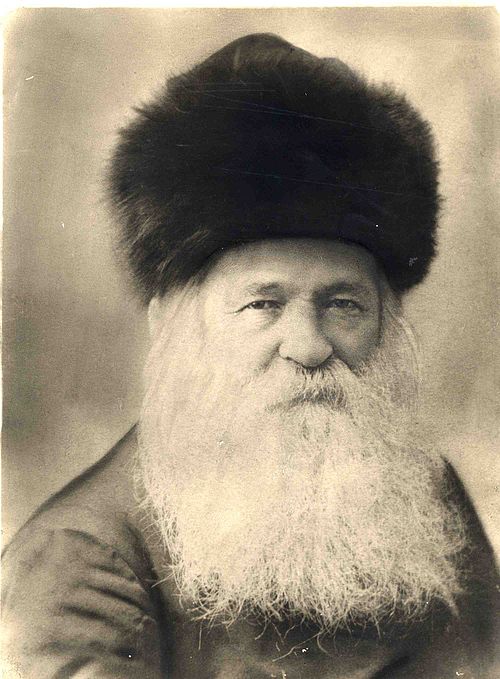
HaRav Chaim Berlin zt"l
A Tree of Life to All Who Uphold It
R' Chaim Berlin revealed that his illustrious great grandfather, R' Chaim of Volozhin, was willing to relinquish his position as rosh yeshiva to another godol, if the yeshiva would benefit by such a change over.
Why was he willing to forego the post? During the year 5583, the yeshiva was so full that R' Chaim was forced to turn to world Jewry for financial aid. Learning of his plight, R' Arye Leib Katzenelenbogen, av beis din of Brisk, offered to help R' Chaim head the yeshiva and to bear part of its financial burden. To this, relates his great-grandson, R' Chaim replied, "I would gladly place the entire leadership mantle on your shoulders, but sharing it with you would be a bit difficult for me."
His famous work, Nefesh HaChaim, written when he was quite elderly, is based mainly on incidents and events which he himself witnessed or heard, and on discussions and debates which he personally conducted on the subjects of Torah and avodas Hashem. However, it assumes the form of a "trail blazer" which formulates the blueprint and lays the groundwork for the establishment and strengthening of a Torah structure. Within its framework, he stipulates primary and secondary goals, worthy and preferable ones.
Above all, he strives to instill his readers with an understanding and an appreciation of Torah's worth. He seeks to pin the entire structure of the Jewish experience on a single axis, from which all the other arms of the structure emerge. That axis is, of course Torah, and yeg'iah in Torah lishmah.
Indeed, all Creation and the entire Universe are maintained only by Torah study. "This is the absolute truth." he says, as he unequivocally stipulates, "Were the world to be without Torah study for even a moment's time, all the upper and lower worlds would immediately be destroyed, and the universe would return to a state of chaos." This is the uncontested truth which, according to R' Chaim, gives impetus to the entire cycle of Jewish life.
To Burn Down an Entire Town
This motif is part and parcel of Nefesh HaChaim, and constituted the credo by which he guided his life, the lives of his students and those of the Jewish Nation at large.
Just how deeply it was ingrained in him, is revealed by the following incident:
A certain student in Volozhin was called "the pillar of the yeshiva," not only because his shtender was located beside the yeshiva's central column, but mainly because he was a great masmid and a highly talented and brilliant young man.
One day, R' Chaim received a letter from the young man's mother, who had recently been widowed. In it she pleads with the rosh yeshiva to send her son home, in order to help her. R' Chaim put the letter in his drawer, and did not reveal its contents to his student.
A second letter arrived, in which she said that her house had gone up in flames, and that the children had been placed in various homes throughout the town. R' Chaim put this letter in his drawer, too, without telling his student a thing.
A third letter arrived, in which she woefully related that the entire city had gone up in flames, and that her children were with no shelter at all. "Please send my son home, so that he can help me care for them," she cried.
There and then, R' Chaim showed the young man all three letters, and asked him to read them in chronological order. The young man was stunned and said, "I understand that you did not show me the letters so that I would not be mevatel Torah. But pray tell, why have you shown them to me now?"
"I wanted you to know," replied R' Chaim, as he proceeded to teach the young man yet another lesson in the value of yegias haTorah, "that your Torah study is so highly valued Above, that the Soton was willing to burn down an entire town, only in order to get you to stop learning."
Later on, R' Arye Levine revealed that the young masmid of our story was none other than R' Yisroel Feimer of Slutsk.
The Difference Between the Amsterdam Shas and the Zoltzbach Shas
But what of the Torah study of baalei battim? How did R' Chaim regard it?
A certain baal habayis in Volozhin was so diligent that it was said that he had reviewed the entire Shas a number of times, and was nearly a boki in it. R' Chaim respected him highly for this, and whenever the baal habayis would enter the yeshiva or the bais midrash, R' Chaim would rise in his honor.
The yeshiva students were perplexed by R' Chaim's behavior. Some even jokingly said that the baal habayis was only a boki in the words of the Shas, but did not always understand its meaning.
When R' Chaim learned what his students had said, he replied: "There is an Amsterdam Shas and a Zoltzbach Shas. The Amsterdam Shas is not only luxurious and expensive, but also complete, for it contains many additions and hagahos. The Zoltzbach Shas is not clearly printed, and contains many typographical mistakes. But would anyone dare say that because of these faults, it lacks the kedusha of a Shas?
R' Chaim not only valued the Torah study of the baalei battim, but also did his utmost to strengthen Torah study among the laymen of Volozhin, where he had served as Chief Rabbi for decades. Although R' Chaim was one of the generation's most brilliant gedolim, this did not deter him, said his grandson the Griz, from "forgoing his personal honor" in order to deliver a daily shiur in parshas hashavua to his fellow townsmen.
"Everyone who entered the beis midrash to hear him," continued the Griz, "emerged the richer, each deriving from the shiur those aspects that he particularly liked. Those who enjoyed pshat, emerged with a deeper and fuller understanding of the literal level of the text. Those who enjoyed gematria, drew from the shiur the tidbits they relished. Just as manna conformed to the varying tastes of those who savored it in the desert, so did R' Chaim's shiur present itself differently to all who heard it."
R' Chaim particularly enjoyed delivering this shiur, and when its set time arrived, he would cease all his other activities, and rush to the beis midrash. The study of Chumash, he would often explain, is different than the study of Talmud, which demands debate and deliberation. At a Chumash shiur all were equal in his eyes.
End of Part 1
|