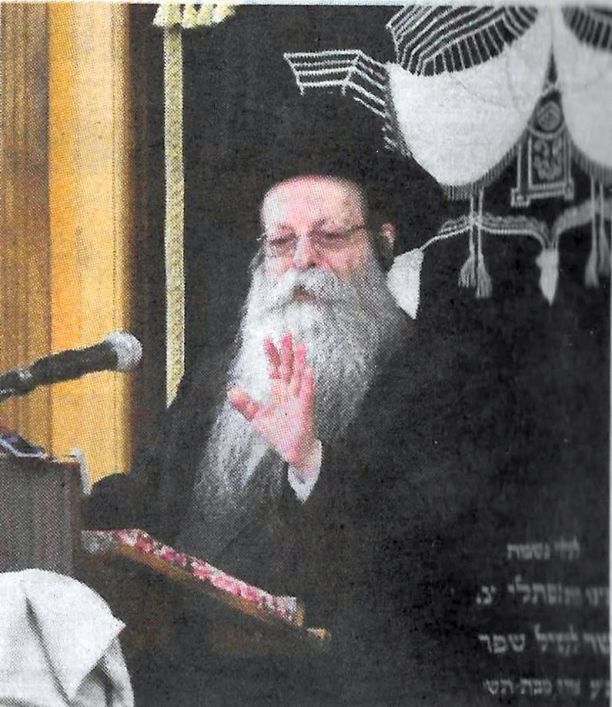
"The following story was related by a tzaddik from a previous generation who found it necessary to travel to a distant city in the month of Elul to participate in a joyous family occasion." These are the opening words of HaRav Shlomo Kanievsky. He continues:
At first he was reluctant to go but family members pressured him to attend the simcha, and he finally agreed. En route, he saw a young goy beating an elderly man. He stopped and asked him why he was thrashing the poor man and received this answer. "It is harvest time now. Our work supports us for the entire year. I am striking this man, my father, who refuses to go out and work since if we do not harvest the crop, we will suffer hunger for the rest of the year."
We are called upon to integrate the important message from the above parable and internalize it into our lives:
It is not always easy to stand on Rosh Hashonoh or Yom Kippur in prayer for long hours. Sometimes we even feel that it is too much, too difficult a task. At this point, we must remind ourselves of the elderly father. These days of Rosh Hashonoh and Yom Kippur are our only opportunity to accomplish what we must do before the chance passes. What is not decreed for us on these pivotal days cannot be changed at another time since this is when the Books of Life and Death are opened, only now. Even if it is difficult, even if we feel incapable of doing what is necessary. It is imperative that we do what is expected of us during those days.
The question begs: Why do we fail to feel and realize this?
HaRav Kanievsky: The answer is that we believe that we know everything, in our intellects. But this does not filter into our hearts because there is a force trying with all its might to prevent it from happening. It is our evil inclination. He is fully aware that if this penetrates our hearts, if we internalize the full significance of this awareness, we will not allow ourselves to be slack, to take the full advantage if this special time. And this is what our yetzer hora so fears!
This, then, is our task: not to submit to the evil inclination but to fight! To remind ourselves time and again, that the very future of the coming year depends on these days. Every heavenly assistance we can muster, both spiritually and materially, every success in our Torah study, in fact: everything! is contingent on our efforts now. If we utilize these days, we are reassured for the coming year. But if not, we cannot make amends on the lost opportunity.
Let us review in our minds all that we and Klal Yisroel experienced in 5786: all the hardships, the trials, the tragedies that we heard about and conversely, for sure — the successes, the happy moments, the achievements and moments of full satisfaction — all of these were determined and grounded on the days of the past Rosh Hashonoh and Yom Kippur. And now, the opportunity is facing us again. How can we not utilize them, or skim over them blithely?
We are aware of people who fell severely ill, and begin realizing that the decree was issued for a certain date, but was ordained previously on Rosh Hashonoh of last year. Alternately, let us remind ourselves of the happy events that people experienced and realize that they were also already determined on Rosh Hashonoh. And if we do so, this Rosh Hashonoh and Yom Kippur will look quite different.
Try to think of a person you know who became seriously ill this past year, or even passed away. Were he able to return to last year's yomim Noraim and change the decree, would he not be prepared to do everything in his power to reverse it? This is impossible, to be sure, since once these days pass, the wheel cannot be turned back. But standing before us in this year, the opportunity awaits us and we can utilize it immensely.
True, it can be difficult, very difficult. But if we place that difficulty upon one side of the scale, opposite the tremendous possibilities and significance of our input — the picture takes on a different look and the hardship diminishes drastically. Even if superhuman effort is required, we can muster those efforts and succeed.
Do you have any advice on how we can make this penetrate our hearts?
HaRav Kanievsky: Certainly. Our very prayers constitute a declaration of faith, of the very realization that Hashem is the One and Only power Who can provide us with all of our needs. But first and foremost, this involves a request. If our prayers do not take on the form of a plea, it can be of no worth and cannot even serve as a declaration of emunah.
One who recognizes that his very health rests in the hands of Hashem and it is His will to bless him with long life grounded in good health without suffering or pain, will he not request good health from Hashem day by day?
One must recognize that it is Hashem Who grants him intelligence to live his life normally, even on an elementary level, to say nothing about being provided with wisdom in Torah and important activities. Shall he not request these things again and again?
One who truly feels and recognizes that everything in his life depends on Hashem — shall he not appeal for them of Hashem all the time?
One who, at the moment, does not really need anything — does he have any guarantee that tomorrow will be the same? The health of tomorrow, the sustenance, the good sense of tomorrow - are all ultimately coming from Hashem - and with this knowledge, shall he not request them all the time? Without them, there is no life! If so, our very plea for these things are a declaration of full faith in Hashem!
I sometimes hear of people who refrain from requesting worldly needs on Rosh Hashonoh and say: On the contrary! Whoever does not ask for these things may probably not feel his total dependence upon Hashem, the source of all good, and does not sufficiently believe that these days are so critical!