| | Feature
An Unrelenting Warrior in Hashem's Army: HaRav Meir Malin zt'l—In Honor of his 32nd Yahrtzeit
by Chonah Horlick
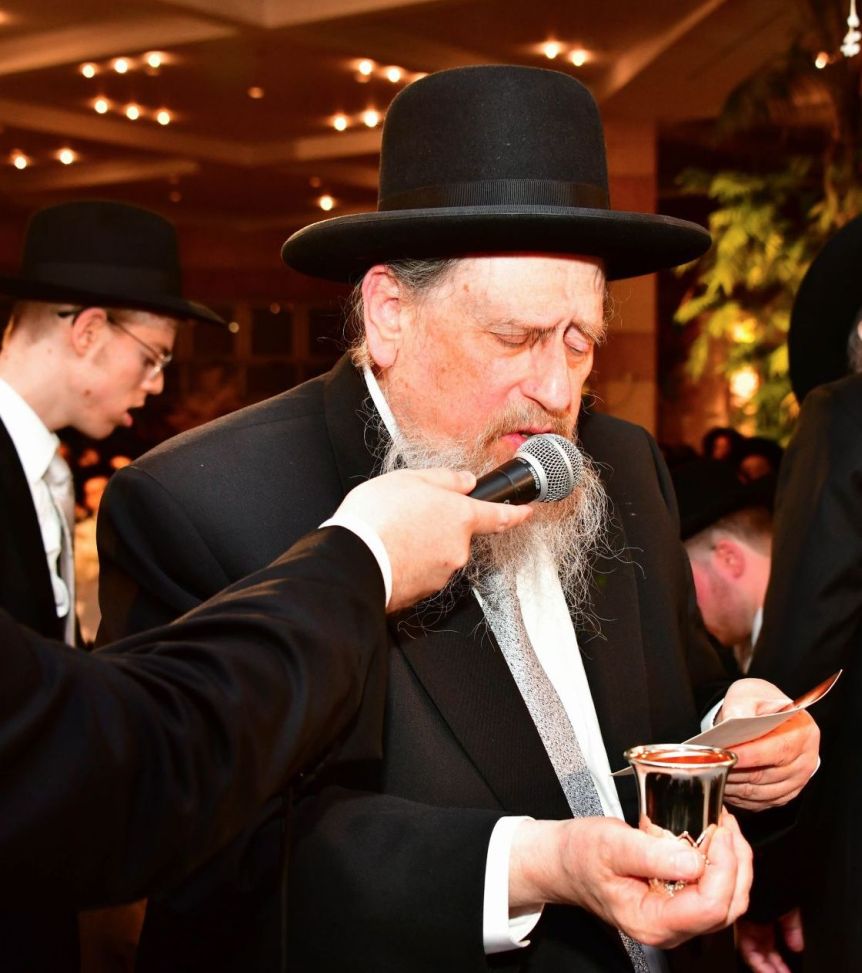
HaRav Isser Yehudah "Yeedle" Malin, son of HaRav Meir Malin zt"l, who carries on the tradition
Part II
This hesped was originally written and published in 1994.
For Part I of this series click here.
More than thirty years ago a woman approached R' Meir in a Washington supermarket. Apparently she felt that she had found someone who would listen to her and help her. She told him with tears that her husband had left her, and that she was alone and destitute, without food for the children.
But there was more to the story: although her father had been religious, she had attended public school and gradually left the way of Torah. She had become a nurse, and in the hospital she met a wounded soldier, who was non-Jewish. From treating his wounds she went on to marry him. Now he had deserted her.
R' Meir first told her how fortunate she was that her non-Jewish husband had left her. Then he gave her a room in the yeshiva building and a job in the kitchen so that she could support herself. Later the father arrived back on the scene, but R' Malin stood up to him and forbade him take the children away. The children helped take care of this point themselves. They told the man, "You are not our father. Rabbi Malin is our father!"
Indeed HaRav Malin cared for them as a faithful father until they married. Today they all head families that are yerei'im usheleimim, and one daughter married a ben Torah who currently studies in a kollel in the Negev.
Eretz Yisroel
Living in America was always a temporary stage for Rav Meir; he constantly yearned to ascend to Eretz Yisroel. During all the years in America, he made it a rule to buy only secondhand furniture — after all, who needs new furniture when he will soon leave the country?
When did R' Meir finally reach the shores of Eretz Yisroel? A month before the Six Day War (in 1967), when many people were fleeing the country out of fear. It was then, of all times, that the Malin family arrived in their new apartment in Yerushalayim, within view of Jordanian territory!
One of the first things R' Meir did was to take his small children to the Mandelbaum Gate between the Old and New Cities of Jerusalem. He went up to the top of a tall building nearby and showed them the site of the Beis Hamikdash so that they could grieve over the churban and the golus of the Shechina.
Even before the war had ended, as soon as R' Meir heard that the Kosel Hamaaravi was in Jewish hands he decided to go there to daven. Despite the danger of mines, and disregarding the fact that only soldiers were allowed to go there, he took his daughter with him in his attempt to go to the Kosel. When a soldier stopped them, he begged so movingly for an escort to the Kosel that the soldier personally drove them there in his jeep.
In 1968 he founded a kollel in Yerushalayim. In 1972 he laid the cornerstone of his life's monument: Knesses Yehuda (named after his saintly father HaRav Isser Yehuda), on a once-barren hillside in Sanhedria Murchevet.
This undertaking was not in the least easy; numerous and great financial and administrative difficulties had to be overcome. These were, however, not the sort of obstacle that could prevent R' Meir from materializing his dream of building Torah in Eretz Yisroel. `Mere' difficulties could not hold such a man back from fulfilling his mission in life.
Besides the unending, and tiring, exertions to raise money for erecting the building and the upkeep of the kollel, R' Meir personally oversaw every phase of the construction. The image of the beautiful shuls of Brisk and Vilna remained etched in his memory, and he fervently wanted "to elevate the house of our Lord" (Ezra 9:9). Every penny donated was dedicated to building and supporting the yeshiva. R' Meir never travelled in taxis; his only means of transportation were bus, subway, or preferably, his own two feet.
The Knesset Yehudah Kollel and Yeshiva

Strengthening Torah And Chesed
The Knesses Yehuda Institutions today comprise a cheder and kindergarten with a total of about one thousand children (k'y), a yeshiva ketana of seventy boys, and two kollelim of fifty young men altogether. R' Meir would arrive punctually each day at all the sedorim of the kollel and would see to it that the members adhered strictly to the kollel schedule. No matter how much he was plagued by his headaches and failing heart, he would arrive on time and learn uninterruptedly with unbelievable zest.
"This is what you shall say to the House of Yaakov" (Shemos 19:3). R' Meir would encourage unfortunate women and cheer them in any way that he could. He also gave thought to women's attachment to Torah. He founded shiurim for women on Mishlei, Tehillim, and Tana devei Eliyahu. He would speak to the wives of the kollel members at the annual Chanukah party, encouraging them in their struggle to raise large families while allowing their husbands to learn full-time, without interrupting their studies for household needs.
He once told a woman that if her child had an ear infection she should not ask her husband to stay home and watch the other children while she took the sick child to a doctor. "Your husband should go and learn Torah, and the child will become well through the merit of his father's learning." And that is exactly what happened each time.
His efforts for Torah institutes did not stop with his own Knesses Yehuda. He advised other yeshivos to settle nearby in Sanhedria Murchevet, and thus transformed the neighborhood into a model of Torah observance.
Some ten years ago, when he was visiting Philadelphia, R' Meir presented a shmuess for yeshiva students on the forty- eight ways to acquire Torah. He went through every one of them individually, explaining it at length and in detail. Those present at the shmuess never forgot it; they said they really felt R' Meir's heart speaking to them. "All hearts speak the same language."
Daf Yomi shiurim were of supreme importance to him. Twenty- five years ago he established one in Mattersdorf, then later another one in his yeshiva, and afterwards in the nearby Pagi neighborhood of Jerusalem. After setting up each shiur he would hand it over to another man to teach daily. Far from being possessive, his objective was to disseminate Torah—what difference was it to him if another person said the shiur? The main thing was that he was helping more people to learn Torah.
R' Meir once entered a barber shop in the Machaneh Yehuda section of Yerushalayim for a haircut. He saw the barber picking up a razor to cut a customer's sideburns, and immediately began a commotion. "How can you do such a thing?" he shouted with a heart full of sincere pain. "Don't you know that it is an issur deOraisa?"
The barber later remarked that for years he had been shaving people with a razor, and no one had ever told him that the Torah prohibits it. A few days later a sign was proudly displayed in the shop window: "We do not shave here with razors."
A hippie chanced upon Rav Malin at Kennedy Airport. After discovering that this long-haired person in ragged jeans was a Jewish male, Rav Malin got to work. "Where are you headed for?" he asked innocently.
The boy replied: "I'm off to India. I want to see what Buddhism has to offer."
"Oh! You're looking for something different," said Rav Malin. "Well, why don't you come to a yeshiva, then? There you will see something really new!" Just then Rav Malin's flight was called, and he parted from this lost soul expecting to never hear from him or see him again.
Years later a young man walked into Knesses Yehuda. The moment he saw Rav Malin, he rushed over to him excitedly. It was the former hippie, who was so moved by the stranger's concern and love that he had taken his advice, and was now a full-fledged baal teshuva.
The neighborhood with the circular street is Sanhedria Murchevet. Ramat Eshkol is to the right.

Failing Health
Such intense activity as Rav Malin carried on could easily be too much for one man, even if he had the natural constitution of a bull. As for R' Meir, sad to say, he had never been blessed with the best of health. In fact, he was a terribly sick man, who had suffered his first heart attack some twenty years before his passing, besides being tormented by splitting headaches and other serious afflictions. His family doctor once said that he had never seen someone with so many diseases. All this, however, meant nothing to R' Meir; for the sake of the Torah he could always dredge up hidden strength.
Eight years ago, while on a trip collecting money for his Torah institutions, he was found unconscious near a gas station in Toronto. After some two weeks of hospitalization he was discharged—and immediately continued his efforts for Knesses Yehuda. Nothing would stop HaRav Meir!
While seeking funds in the U.S.A. some six years ago for his kollelim, yeshiva, and cheder, all the arteries to his heart suffered severe blockage. The doctors decided that an operation must be done, but they could not even guess at the chances of success.
The night before the operation R' Meir sat up, pleasantly learning gemora as if the operation was scheduled for someone else. His first words after coming out of the anesthesia were that he had missed mincha. Only ruchniyus interested him—his sole aim in life was to serve Hashem!
After a heart failure two years ago, he was brought to the Hadassah Hospital on Mt. Scopus. Upon hearing that his personal cardiologist was Professor Gottesman, the doctors consulted the Professor on how to care for Rav Malin. The professor answered that the Rabbi was in any case only living by a sheer miracle, and only Torah kept him alive, so they might as well treat him according to standard procedure.
Five months ago, suffering from fluid in his lungs, HaRav Meir asked a nurse in the Mt. Scopus Hospital to wheel him to the shul on the first floor. Later on the other nurses of his ward searched high and low for him. It never occurred to them to look in the shul. They did not imagine such a sick person would attempt to go to shul. Of course, they did not know— yet—that they were dealing with a person totally devoted to Hashem, someone who would strive unceasingly to serve Him.
Just a month before his petiroh he was unable to breathe unassisted (for the last year of his life he kept an oxygen tank in his apartment—a fact known only to few). Despite this he would still go to his kollel at the start of the morning seder and sit and learn there with unalloyed pleasure for four hours straight.
Even while sick in hospital, R' Meir could not forget his mission in life. He would try to draw the patients around him, and the nurses who treated him, closer to Yiddishkeit. He asked his granddaughter to keep in contact with these people after he had left the hospital, and even checked on her to be sure that she was persisting in showing them the way to Torah.
R' Meir did every mitzvah with his entire heart. At the seuda mafsekes before Tisha B'Av he would cry out in anguish while thinking about the destruction of the Beis Hamikdash. At Simchas Torah he would dance enthusiastically without resting. Even this last Simchas Torah he danced with a sefer Torah, refusing to show any signs of his deteriorating physical condition. In the morning, though, he took a bad turn, lost consciousness, and was rushed off to the hospital in critical condition. He never regained consciousness, until on Sunday, 27 Tishrei, he returned his holy soul to the Creator.
The rabbonim of Washington DC around when the Malins were there.

A Tzaddik's Memorial
During the shiva for Rav Malin, a well-known tzaddik called from Bnei Brak. He said that when he was thirteen years old and homeless, R' Meir Malin had picked him up off the street, taken him to his house, and fed him. His stay with the Rav imbued with such a love for Torah that he went on to study in a yeshiva. "I owe him everything," he said. "Whatever I am today is entirely by R' Meir's zechus!"
In a New York subway once, R' Malin met a forty-year-old fireman. In the course of their talk R' Meir advised him to come to Eretz Yisroel. One would not expect anything really to come of such a chance conversation, but that would be vastly underestimating R' Malin's powers of persuasion. One day not so long after, this man appeared in the yeshiva in Sanhedria Murchevet! After being Rav Malin's guest for many meals during the week and on Shabbos, he became a baal teshuva, married, and settled down in Eretz Yisroel. R' Meir learned with him for endless hours despite the fact that this man had an extremely poor level of understanding.
While living in Kiryat Mattersdorf, R' Meir would make kiddush every Friday night and Shabbos morning for a widow who had no nearby relatives. After the Malins moved to Sanhedria Murchevet, they did not forget her: they invited her over every week for Shabbos. When this lady died some twelve years ago while waiting at a bus stop, HaRav Malin was notified. At that time an autopsy was often performed on those who died in Eretz Yisroel without relatives. HaRav Malin rushed over to the hospital and declared that he was her son and was opposed to any autopsy on her.
Even children were not forgotten by R' Meir. He used to go to the grocery store lichvod Shabbos, to buy candies for his family, and any child he met on his way home would receive some candies. It often happened that he arrived home empty-handed, after having given out all the candies he had bought.
If a child of a student in his kollel or of a neighbor was sick, he would call several times a day to hear how the child was feeling, and would daven for him until he had recovered. R' Meir even went all the way to a hospital once to visit a neighbor's father who was sick. He tried to ease the old man's suffering, and discussed his case with the doctors and nurses. The grandchildren were amazed at the genuine worry the Rosh Yeshiva felt. And all this time he himself was seriously ill and in pain.
A neighbor who was childless was astonished when the tzaddik offered to pay half of his expenses to fly to America and visit experts who might be able to help in his particular case.
Not only did R' Meir excel in chesed but also in his hasmodoh. After a day spent supervising the kollel, trying to attract potential donors to support Knesses Yehuda, and overseeing the building at Knesses Yehuda, he had already exerted his sick body beyond its strength. Yet the very moment he had a chance he would sink into the gemora. Neighbors who woke up in the middle of the night or who returned late from a simcha would always see the light on in the porch and R' Meir learning. He would tell the kollel students that if they are awakened by the crying of a child, there was no need to return to sleep again; "the child's crying has been sent to tell you to sit and learn even in the middle of the night."
The daf yomi shiur was attended by one man who had learned in the past in a yeshiva. When the shiur came to an especially intricate sugya, Rav Meir suggested to this man that since he was a former yeshiva student they should learn the page together. It was late at night then, and the man was exhausted from a day's work and a shiur. He simply could not absorb what R' Meir was saying. Undismayed, R' Meir repeated everything time and again.
Much later R' Meir looked up at the clock and saw that it was one in the morning. He turned pale with emotion, took the man by the arm, and said: "You are a working man and you have worked the whole day, yet you are still able to learn with such mesiras nefesh until one o'clock in the morning, and such a difficult sugya, too! I want you to come and learn with me every night."
In monetary matters R' Meir was as meticulous as with every other halocho. Last year, before Rosh Hashanah, he borrowed a few thousand shekalim from a contractor in order to pay the workers for the new building. On erev Succos R' Meir was seen wandering around Kiryat Moshe trying to find the contractor's home, in order to repay the loan. The contractor was so moved that he came to participate in the yeshiva's Simchas Beis Hashoevoh, at the end of which he returned the check and told R' Meir that it was a donation.
Few men, very few indeed, have been so totally devoted to Hashem. Despite losing all his family in the Holocaust, and being in such poor physical condition, wherever he was—even in remote continents—and whenever it was—even when he met someone by mere chance—he exerted himself to the fullest to serve HaKodosh Boruch Hu.
On the gravestone of Rav Meir Malin's great grandfather is engraved "A man who had spirit in him" (Bamidbar 27:18). Undoubtedly this is also an apt description of the tzaddik, the gaon HaRav Meir Malin, who with his unrelenting spirit, was such a faithful servant to Hashem.
|