| | Feature
Jewish Blood for Jewish Money: The Story of 'The Europe Plan'
By Sammy Kaufman
Rav Michoel Dob Weissmandl zt"l
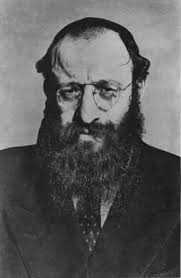
For Part II of this series click here.
This was originally published in 1995.
Part 1
Introduction and Overview
By Autumn 1942, the executioner's ax had already descended upon most of the Jews in Eastern Europe, the heartland—or Bludzentrum—of European Jewry. The Germans' thirst for Jewish blood was largely slaked. Their fighting spirit was also diminishing as the tide began to turn against them with their defeat at El Alamein in October and the beginning of the Russian counterattack at Stalingrad on the nineteenth of November.
By this time, the decimation of European Jewry was known all over the world.
In Eretz Yisroel, on the twenty third of November, the Jewish Agency for Israel issued a statement (after deliberately having withheld the news for several weeks,) which sent shock waves through the yishuv and brought the European destruction to the forefront of public discussion. On the seventeenth of December, the United Nations issued a condemnation of Germany for murdering the Jews, which was published simultaneously in London, Washington and New York. Some of the Nazi leaders began to fear for their futures, notably Himmler, who stood at the head of the entire apparatus of execution.
There were early negotiations with the Nazi Dieter Wisliceny, which led to the suspension of the transports of Slovakian Jews to the death camps in Poland. "Behind Wisliceny, who led the negotiations with the workers in Bratislava, stood Himmler himself. From November 1942 until August 1943, he negotiated halting the European devastation. Through agents, Himmler proposed meeting the head of the Joint, Joseph Schwartz, in Spain in order to negotiate the cessation of the killings." (H.Ager, The Remnant That Remained)
"A year later, in October 1944, Himmler ordered the that the total destruction of the Jews be suspended. His order was carried out, remaining in force until the end of the War." (S.Bet Tzvi, Post Ugandan Zionism During The Crisis Of The Holocaust)
This article will survey the history of these negotiations, concerning what was known as The Europe Plan, from its conception in Rav Weissmandl's mind until it's final dismissal by Himmler, as a direct consequence of the refusal of the highest echelons of the Zionist leadership to test the seriousness of the Nazis' intentions.
"The fact that Himmler was behind the negotiations increased the probability of the agreement's realization to the point of being almost certain. Although money was demanded in return for stopping the expulsions, it is inconceivable that this was what motivated Himmler. It is more likely that the negotiations themselves were his object. It can be assumed that two years before he halted The Final Solution, Himmler was already entertaining doubts and suspicions about how ultimately purposeful the destruction of the Jews would be to Nazi Germany and to himself." (S. Bet Tzvi ibid.)
The Slovak Republic that existed 1939-45

The Idea
The plan that was later known a The Europe Plan, presented itself to Rav Weissmandl in September 1942 while he was in prison as a result of a search carried out by the Slovakian authorities in the Orthodox Chamber which had led to the discovery of receipts for money and other articles which had been sent on erev Yom Kippur to Jews in Lublin. (Rav Weissmandl, Min Hameitzar)
Rav Weissmandl writes, "On Succos 5703, I said the hoshanos while I was surrounded, together with the other prisoners, in the prison courtyard. On Hoshanoh Rabba, I said to myself, 'We see with our own eyes that there is a way to bribe the wicked Germans to annul their decree, for the sake of our brethren who remain in this country. We must therefore test this avenue of escape for the sake of the two or three million of our brothers who remain alive throughout the occupied lands. I undertook that if I would emerge from incarceration b'ezras Hashem, I would start to work... to prevent the expulsions ...and the murders in the death camps." (ibid.)
Rav Weissmandl was already acquainted with the refusal of Jewish lay leaders to come to the aid of their Slovakian brethren. He hoped however that, "If our country and the thirty thousand who remain alive in it are of no consequence to the communal leaders in the free lands, they [nonetheless] will make every effort, overcoming every obstacle, every hesitation and every argument, for the sake of the Europaplan [in order] to save two or three million." (ibid.)
His father-in-law and mentor, HaRav Ungar, was more realistic. "When I returned to Nitra on Isru Chag Succos 5703, and put my idea to Admo"r, zy'a, he strongly believed in that course of action and encouraged me to work on it. He placed no faith however, in the large Jewish organizations and said that a way had to be found to contact the rabbonim and the leaders of observant Jewry, who feared the Torah's laws, rather than those of the gentiles. No trust whatsoever should be placed in Jewish heretics and haters of Torah.
"Since we ourselves had seen that our cries had hitherto gone unanswered, [said the Nitra Rov,] we ought to fear that it would be the same this time as well, even if this [time the] rescue plan concerned millions." (ibid.)
Rav Weissmandl asked his childhood friend, Boruch Meshullam Leibovitz who lived in Zurich, to send him impressive looking envelopes containing blank sheets of writing paper bearing a Swiss insignia. He printed a letter on these sheets which was signed with the fictitious name, Ferdinand Roth. The letter read, 'Uncle is very pleased to hear that little Willy has passed his school test so well and is therefore sending him a gift. If he continues this way in high school, Uncle will undertake to support him completely, for good. He hopes to come soon to visit us all, especially Willy.'
The letter was given to Hochberg [Wisliceny's Jewish aide] while the key to the coded message was conveyed verbally: The elementary school was Slovakia, the high school, all of Europe. Willy was of course Wisliceny while Uncle was world Jewry.
Like all the Nazis, Wisliceny believed that world Jewry had some magic power that even at this late stage of the War, could ensure his own safety. He consequently swallowed the bait eagerly, travelling to Berlin in October and returning with the consent of his superiors, Eichmann and at a later stage, if not already then, Himmler as well." (ibid.)
The following information is contained in a letter written by Ondrej Steiner [one of the members of the Working Group] to researcher Yablonka, dated the twenty-eighth of May, 1984.
1) The instigator of The Europe Plan was Rav Weissmandl.
2) Wisliceny obtained the consent of the higher authorities to the plan, if I am not mistaken, from both Eichmann and Himmler. The best proof of this is that The Europe Plan was later adopted by the Jewish leadership in Budapest, serving as the basis for negotiations with other, German authorities.
Around the middle of October, Gisi Fleischmann wrote a letter in German about the plan which was taking shape. (Min Hameitzar, document 24) Rav Weissmandl also wrote a lengthy letter in loshon hakodesh, containing details of his suggestion. His letter bore a diplomatic seal and was taken by a messenger to Saly Meyer. (ibid.)
Rav Weissmandl informed Meyer that Eichmann and the other leaders of the Nazi regime were men who could be bribed and that Himmler was also apparently aware of the plan. He wrote further that the Germans were prepared to grant entry to an emissary of World Jewry who came to negotiate. In order to encourage a swift reply, Rav Weissmandl revealed that Hungarian Jewry were in danger of expulsion and that something should be done to try and save the remaining Jews. (ibid.)
In her reports of the negotiations, Gisi Fleischmann used to periodically mention Wisliceny's good track record as well as her own opinion that the positive attitude taken by senior Germans to the discussions was due to their viewing them as a political instrument.
"In their reports," writes Na'ima Barzel, "the rabbonim make clear their awareness that the Germans' political aim is the extermination of the Jews, however [they reported] certain departures from that course were possible, due to the power games taking place within the German hierarchy. The Germans were interested in trading in Jewish blood." (Na'ima Barzel, The Working group And The Slovakian Zionist Leadership, 1941-44)
A Memorial to the Working Group in Bratislava

Dashed Hopes
Letters from the Working Group were sent to Saly Meyer, the Joint's Swiss representative, to Nathan Schwalb, the representative from Eretz Yisroel to the Swiss office of Hechaultz and to Mr. Silberschein, the Swiss delegate to the World Zionist Congress. In addition, Rav Weissmandl and Mrs. Fleischmann wrote to the workers from Eretz Yisroel in Constantinople. (Dr. A. Fuchs, The Unanswered Cry)
Wisliceny made another trip to Berlin in November, concerning the stoppage of 'The Final Solution' in the light of World Jewry's willingness to negotiate. Eichmann promised him that he would discuss the matter with Himmler, despite his own opposition to the plan. (Min Hameitzar and Fuchs)
Rav Weissmandl had good reason to be glad at the successful beginning of the discussions of the plan he had hatched while in prison. Unfortunately, he was still somewhat naive concerning the priorities of the leaders of the yishuv.
Had he been able to listen in on a meeting of the board of the Jewish Agency, he would have been swiftly enlightened. On the twenty-fifth of October, after information about The Final Solution had reached Yerushalayim, Yitzchak Gruenbaum requested that one hundred liras be designated for the sending of telegrams, in order to receive further information and enlist the help of Jewish organizations in chutz la'aretz. The Agency's Treasurer, Kaplan, argued that fifty liras would be sufficient. Shertok [later Moshe Sharett,] supported Kaplan. (Walter Laqueur, The Terrible Secret)
On the fifth of November, Rav Weissmandl and rabbi Armin Frieder wrote again of the good chances of the Plan's success adding, "However, we are unable to start until we know the extent to which the worldwide community is able and willing to designate money for this great project. Please send a clear-cut reply, without ambiguity." (quoted by Fuchs)
The bitter truth soon dawned upon them. Negative responses from Meyer and Schwalb arrived to the first letters written by Rav Weissmandl and Gisi Fleischmann. "The answer was, 'Definitely not,' in clear and emphatic terms. They were bound to uphold the law of the Allied powers, which prohibited taking a single penny into enemy territory... Let the Germans first show that they were truly repentant by stopping the killings, it would be possible to talk afterwards." (Min Hameitzar) The reply went on to say that the Working Group should try and appease the Germans with delaying tactics, placing their trust in an Allied victory. (ibid.) Rav Weissmandl was horrified by this answer which in his words, "prevented the possible rescue of thousands upon thousands." (ibid.)
The Conditions
Another letter signed by himself was sent to Meyer on the first of December. At the same time, letters were also sent to the Jewish Agency, the world Zionist Congress and to several individuals in Switzerland. They were asked to read the letter and to forward it to their superiors in the United States, England and Eretz Yisroel. Together with the letters, testimonies about the murder of Slovakian Jews in Balzac and Treblinka were enclosed. (ibid.)
"The consul (Wisliceny) has just returned from the city of his Government (Berlin,)" Rav Weissmandl and rabbi Frieder wrote, "and in an agreement with the head official (Eichmann,) he has stipulated the following conditions:
The cessation of expulsions from all of Europe, with the exception of Germany and the lands of the Protectorate, will take place sixteen days after the conclusion of a formal agreement according to mutually acceptable conditions. It will be possible to achieve great relaxations of the restrictions in Poland.
1) To write once a month and to receive one letter a month.
2) To receive monthly parcels of clothing weighing one kilogram.
3) To send parcels once a month..via the Judenrat... up to a hundred kilograms in weight.
4) To annul the order of secondary expulsion [i.e. to the death camps].
5) To allow the exiles to contact each other in writing.
All these conditions will be fulfilled sixteen days after the conclusion of a formal agreement according to mutually acceptable conditions.
"This was the consul's communication. So that you can make a proper judgment, you should know that this consul of ours has fulfilled his promises in the past, down to the letter. Remember the hundreds upon hundreds of thousands who are about to be transported as well as the hundreds and hundreds of thousands who are being condemned to death. Our view, at which we have arrived after deliberation and judgment and which takes into account our experiences, is that there is a good possibility of rescue. It seems never to have happened before in all our history, that Jews have ruined a chance to rescue their brethren simply because of their attachment to money... as we wrote to you in our first letter, informing you of the amount that could be sent... but in the name of Knesses Yisroel, we bind you by oath not to engage in lengthy wrangling over this matter for during the weeks that we have been waiting for your reply, many tens of thousands of new refugees have been exiled and hundreds of thousands have been murdered R'l. Send us a clear and a good reply immediately."
Referring to the argument that the Jews in the occupied lands should trust in an approaching Allied victory they wrote, "Please listen to us and when you sit down to discuss this matter, imagine that the War will still go on for years chas vesholom, and will extend to countries that it has not yet reached, as it is very likely to do, in our opinion. When you regard things in such a light, you will be able to come to a conclusion on this great and fearful issue... As to the prohibition against taking out money, we must point out one thing, namely, that the United Kingdom spends vast sums sending food and staples to Greece, as is well known. Let our brethren who are living amid comfort and blessing boruch Hashem, look upon the lives of their brothers who are living under oppression, who are dying from plague, the sword and starvation and who are being cooked into soap R'l, in the same way that the English look upon the lives of the Greeks.
"We must note in this connection that if we could have concluded an agreement six weeks ago [when the first letter was sent] hundreds of thousands could have been saved. The same number of lives can still be saved. Do not delay. The blood of your brothers and sisters is crying out to you from the land that has been cursed by Hashem. Please see that you help. May Hashem be with you." (Min Hameitzar)
On the fourth of December, three days after this letter was written, Schwalb informed his colleagues in Constantinople about it. "In my last letter, I told you about the successful negotiations over the remnant in Slovakia. A [new] proposal has arrived from the community and the rabbonim."
After detailing the Germans' conditions, as they appeared in Rav Weissmandl's letter Schwalb writes, "I will tell you what I think. Regarding Slovakia, I entertained doubts, both in principle and in practice, whether to hold discussions at all and whether we should believe their promises. The Slovakian arrangement proves that they keep to their word after all... these tyrants have their own private reasons as well. They are thinking about their futures. They may be trying to lessen their guilt by means of these concessions. In practice, the payment for the arrangement is to be divided so if it is not fulfilled, payment can be withheld... I do not need to tell you with what eagerness I await your views." (Central Zionist Archive, henceforth C.Z.A.) So it was that "In Constantinople, they knew already by December about 'The Rabbis' Proposal' as a basis for possible negotiations with the expelling powers.' (Barzel)
Desperation
Rav Weissmandl kept up his entreaties. On the twenty-third of December he wrote again,
"Sholom Ubrocho to whomever this concerns, we have written twice to inform you that with money, it is possible to save 1) many thousands from being transported to their deaths, 2) hundreds of thousands from being murdered and 3) to obtain permission to send money and parcels to the deportees.
"...We do not understand how you can eat and drink, how you can sleep on your beds and how you can go strolling outside, while you carry this responsibility. We have been crying out for months and you have still done nothing. Please forgive these expressions of anger but we are unable to restrain ourselves in the face of such carelessness. I am sure that after Hashem's salvation, you will berate yourselves when you see that you had the power to rescue but did not.
"Do yourselves a favor and prevent the regret that will later consume you, for the Jewish people are holy. We are asking for action, not deeds of heroism or self sacrifice but simply handing over money. Hundreds of thousands of lives depend on money... today, money is worth life. Take this to heart and acquire great merit for yourselves, for your brothers and their children and young ones—life and perpetuation amongst the remnant of Yisroel, Michoel Dov." (Yad Vashem Archive, quoted by Fuchs)
Besides undertaking The Europe Plan, the members of the Working Group had to continue bribing the Slovakian authorities and the German officers on Slovakia, in order to hold off the deportation order that threatened the Jews in Slovakia.
Mrs. Fleischmann visited Hungary to seek aid for this latter mission. She met members of the Zionist leadership there and on her return she wrote to Switzerland (her letter is dated the fourteenth of January 1943). "I must say without any personal bias that our friends there have neither love for their fellow Jews nor even natural social feelings."
Her letter ends with, "Our request in this hour of calamity is: please knock on the entrances to the hearts of the Jews who are living peacefully on the other side of this border. Arouse them so that they will disturb their tranquility and finally recognize their obligation as human beings, to save their brothers from destruction. We are only asking for money which can be replenished at any time whereas once human life is lost, it cannot be retrieved." (Min Hameitzar Rav Weissmandl translated this letter into Hebrew, see document #21 at the end of his book.)
A reply did come but it did not contain a promise to pay money. Instead, the Jewish leaders wished to lay down a condition of their own. On the fifteenth of January, Rav Weissmandl therefore wrote again, this time spelling out the conditions under which the members of the Working Group had to operate, representing the Jews of their country to an occupying power. Great danger would await them, he wrote, if the negotiations were to reach the stage of practical details while the Working Group still lacked financial backing. They could hardly ask the Germans what their demands were for the response to such a question, "will bind us. If we fulfill their condition then good but if chas v'sholom not, that is, if we don't have the money, they will take lives instead. Red (domim) blood instead of golden (domim) money."
It was preferable, he argued, that the Jewish bargaining partner made an offer. Rav Weissmandl was of the opinion that "we need to blind them with at least a million dollars... first there would be a down payment... of ten percent..."
Referring to the proposal contained in the letter he had received Rav Weissmandl wrote, "there is no way that we can agree to what you suggest... we cannot lay down any binding conditions... [which would mean] calling off the negotiations if they do not accept your condition. They can spill our blood while you will only be able to spill tears. There is an imbalance of power... however, we need not estimate their trustworthiness at more than ten percent."
Again Rav Weissmandl stresses that, "We will not instigate a single discussion until we know for sure that the money is secure, even if it be in your hands..." for, "our beginning [in such a way] would be the end. This is our opinion. Please inform us of yours." (quoted by Fuchs)
End of Part 1
|