| | Feature
The Power of Torah Shebe'al Peh: Learning Mishnayos for the Merit of the Deceased
by Rabbi Tzvi Yabrov

Part III
This final part is a further discussion of studying Mishnayos to benefit deceased relatives.
For Part II of this series click here.
True Merits For The Deceased
In a passage in Igeres Hateshuvah (Drush Shlishi, Yom Vav, Siman 79) Rabbenu Yonah discusses the great merits accredited to parents when their children learn Torah and keep the mitzvos.
"A woman should be careful to pray every evening, morning and noon. At the end of her prayers, her principle supplication to Hashem should be that her sons and daughters fear Him and that her sons be successful in their Torah studies, for a woman earns her principal merits in the world to come when her children serve Hashem, fulfill His will and fear Him. After she has reached her own world, having left behind children who carry the fear of Hashem in their hearts and who involve themselves with Torah and mitzvos, it is considered as though she were still alive and fulfilling all the mitzvos herself. She thus merits the highest levels in the World to Come."
The Chofetz Chaim zt'l, in Ahavas Chesed (chap.15 footnote) writes in very strong terms against people who erect tombstones of expensive marble engraved with gold lettering and other artwork, or plant trees or create some other type of picturesque scenery, because they wish to create an everlasting memorial to their parents. They spend vast sums of money, believing that they are bringing great pleasure to the souls of their deceased loved ones in this way.
Concerning this practice, the Chofetz Chaim comments: "How greatly mistaken these people are in this belief of theirs. The truth is that after its departure from this world and its arrival in the world of Truth, the soul of the deceased recognizes that Torah and mitzvos are the only things that are ultimately desired. It sees that they are considered there to be the finest "merchandise" that is valued in all the worlds... The soul then regrets having squandered away its days in this world in pursuing vain pleasures and imaginary honor, for which it must now give account.
"This being so, imagine what kind of pleasure the parent's soul gets to see his sons, to whom he devoted all his labors and upon whom he relied in his lifetime to save him from the Divine judgment through their correct and upright behavior, as they instead go and add further worthless pleasures over and above those which he collected in his lifetime.
"They would do better to erect a less costly tombstone, engraved with plain lettering rather than gold, without decorations and without any trees. With the money they save in this way, they should buy a Shas and donate it to a beis hamedrash, inscribing it in memory of their parents' souls. Alternatively, they could use it to start a loan fund in memory of their parents. This would bring a tremendous elevation to their parent's souls, for, with each loan given, another positive Torah commandment is fulfilled and a further merit is credited to their parents."
The Chofetz Chaim goes on to quote from Yesh Nochalin who writes that all the merits acquired by a son and all the mitzvos he fulfills after his father's petiroh are an atonement for his father's soul, even though the son fulfills them on his own initiative.
The Shloh, the son of the Yesh Nochalin, adds the following comments: "Not only does the son thus save his father from the judgment of Gehennom and release him from suffering, he also gains entry for his father into Gan Eden and places him in the same dwelling as the tzadikim, as the Zohar states (at the end of parshas Bechukosai): "A son shall honor his father." Even though he has died, he is doubly obliged to honor him. If the son follows the path of evil and failure, he certainly disgraces his father by doing so. If, on the other hand, he follows the path of good and upright behavior, and his actions are correct, then he brings honor to his father both in this world, in the eyes of those who see him and in the world to come, before Hashem. Hashem then has mercy on the father and places him on the throne of glory. Now, if it is in the son's power to bring such honor to his father, it is certainly within his power to ensure that his father will escape the judgment of Gehennom."
After quoting from the Yesh Nochalin, the Chofetz Chaim continues, "A person should imagine to himself, how great his desire would be, were he cast into the flames, or made to undergo some other kind of fearsome pain, for his sons to intervene on his behalf in whatever way they could, in order to save him from this dreadful penalty.
"A man should ensure that this is what he does for his parents' souls, saving them by virtue of his good deeds from bitter punishment for their sins. This applies especially during the shiva and shloshim, for the power of judgment is at its strongest during this time, as is known. He should increase his learning, his tzedaka and his acts of kindness, as far as he is able, for in this way he will save them from the judgment of Gehennom and will gain them life in the world to come. This should be borne in mind by every living person and when his own time comes, others will act towards him as he himself acted..."
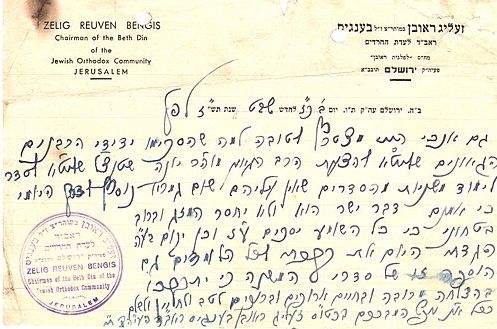
A letter from HaRav Zelig Bengis zt"l encouraging Mishna Yomis
What Merits Do Tzadikim Need?
Rabbi Chaim Falagi zt'l, was presented with the argument that if a person's father had been a tzaddik, there was no need for the son to read the haftorah or to say Kaddish. Since the purpose of these mitzvos is to save the father from Gehennom, they would be unnecessary in the case of a tzaddik.
In his sefer, ShU"T Chaim Bayad, Rabbi Falagi disagrees with this claim for a number of reasons. The first of these is that since only Hashem sees into a person's heart, we cannot really know what anyone's true level is and therefore we should undertake to make a correction for the benefit of the soul.
He then continues as follows, "Besides, even if we concede that they were totally righteous and are in no need of our mitzvos and our learning to save them from the Divine judgment as they possess many of their own merits, the son's Torah and mitzvos provide wider berth nonetheless. Over and above his own merits, the father's spirit receives great satisfaction on his son's account as well. Who was greater in Torah and piety than Rabbi Shimon Bar Yochai zy'a, yet the holy Zohar still says that his holy son Elozor's Torah was of benefit to him..."
In support of this, he quotes the Shov Yaakov (ShU"T Even Haezer, siman 15) who writes that Kaddish brings great benefits to the departed soul, for hidden reasons, being neither an atonement, nor a way of saving the soul from Gehennom.
Rabbi Falagi then continues, "It appears to me that a further reason is that through a son's involvement in Torah, mitzvos, tzedaka and the support of Torah scholars for the elevation of the souls of his close relatives, including his father and mother, even though they may have been righteous and pious individuals, the son merits that in the upper worlds, his relatives, in their righteousness, will pray for him to enjoy long years, riches and honor for his deeds and he will receive the bounty bestowed from on high, a bounty of salvation and mercy."
The Kitzur Shulchan Oruch (26:22) concludes his lengthy discussion of the laws of Kaddish yosom with the following comments:
"Although the saying of Kaddish and leading the tefillos is of benefit to the parents, these are not the most important things. What is most important is that the sons follow an upright path and by doing so they will provide merit for their parents... A person should instruct his children in the performance of certain mitzvos and if they fulfill these, it is worth more than the saying of Kaddish. This remedy is good even for someone who has only daughters."
Rabbi Tzvi Hirsch Kaidanover zt'l in Kav Hayoshor (perek 35) discusses the widespread custom of fasting each year on the yahrtzeit of one's parents.
He writes, "Saying Kaddish and fasting helps to avert a part of this judgment but they are not enough by themselves. One should be sure to find some good to perform on that day. If he is a Torah scholar, he should see to it that he develops a chidush in Torah, with pure intentions. The son then brings joy to his father and mother and adorns them with numerous crowns. If one has merited marrying off his daughter to a talmid chochom who composes new words of Torah, containing true Torah insights, then the father and mother-in-law are similarly adorned with crowns."
American Pirchei Mishnayos

In his testament (which appears in Menuchoh Ukedusha pg.22) Rabbi Naftali Hagodol zt'l, writes similarly, "My request of you is that you act faithfully towards me after my death, to achieve tikkun for my soul. In this respect, the dead receive an inheritance from the living, for the deeds of the son are a merit for the father. Conduct yourselves according to the instructions I am giving you in this testament:
Say Kaddish for the first year, up to and including the twelfth month... However the kaddeishim are of less importance than the tefillos for the former were instituted to be said by children or uneducated people who are incapable of leading the tefillos. Be sure then to observe the principle stratagem of leading the tefillos, saying Kaddish and Borchu. Gather a minyan if at all possible, even if you are out in the fields, so long as no danger is involved. Teach a regular shiur every morning after the tefillah. This learning and the Kaddish, if a minyan is present enabling Kaddish derabanan to be said, will be mine. If there is no minyan, then just the learning will be mine..."
We conclude our discussion with the fiery words of Rabbi Eliezer Pappo zt'l in his Pele Yoetz (under the letter caf, pg. 156): "The main form of honor is that after his father has died, the son should do whatever is within his power in order to bring satisfaction to his father's soul. He should do this daily, never forgetting his father, unlike many of the ignoramii who only remember their parents on their yahrtzeit when some of them say Kaddish, give a little tzedaka and learn a little..."
In the opinion of the Pele Yoetz, not a day of the son's life should pass without him saying Kaddish and giving tzedaka for his parents' souls. In his words, "He should not only do this during the first twelve months and then on the yahrtzeit each year, for who in this orphaned generation is cleansed from sin after a mere twelve months and is then ready to rest and rise again to receive his due. We ought to suspect that this may not be the case. Moreover, saying Kaddish is not only for saving the deceased from punishment. It also brings about an elevation of the dead person's soul."
He then goes on, "It is therefore correct for a son to have his father's image before him all his life, imagining his father to be screaming bitterly from the midst of burning flames saying, "My beloved son! Favor me! Favor me! Save my soul from the sword and from the dogs!" Even if the son thinks that his father was a perfect tzaddik and that his soul is enjoying lush pleasures, he should imagine himself to be feeding his father his favorite delicacies in order that his father's soul should bless him. He should not let a single day of his life go by without saying Kaddish and giving tzedaka for his parents' souls."
The Pele Yoetz concludes thus: "How good it is for the following prayer to be on his lips each day, `May it be Your will...that You receive every good deed which I perform, whether it is a good thought, a good word or a good action, with mercy and acceptance. May they all be reckoned for the merit and the tranquil rest of the souls and spirits of my father and mother, my father-in-law and mother-in-law etc. May it be Your will that their souls be bound up in the tzror HaChaim."
|