| | Feature
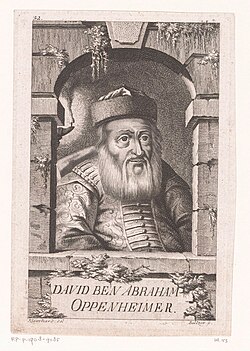
The Jews Called Him King: R' Dovid Oppenheim
by N. Aviam
Part 1
This was originally published in 5636.
For Part II of this series click here.
"Everything is dependent on mazal, even the sefer Torah in the heichal," said Chazal. Just as sifrei Torah in the heichal are dependent on destiny, so, sometimes are living sifrei Torah, the talmidei chachomim of each generation. Even one who has labored in Torah and, with siyata deShmaya has grown very great, is still to a degree, dependent on mazal.
So it was with the gaon, R' Dovid Oppenheim, Rav of Nicholsberg and then of Prague and the Bohemia region. This illustrious gaon was one of the greatest gedolim of his time enjoyed outstanding Torah and wealth. Although he was highly esteemed by his co-generationists, nonetheless, after his death, his name was eventually forgotten. Many bnei yeshivos don't even know that there was such a person.
The same fate befell his written works. Except for a few responsa that were printed in various other seforim, all of his writings remained in manuscript without anyone attempting to publish them. All this occurred, despite the fact that many of the works of the rishonim which Torah students and scholars use on a daily basis, were made accessible only due to his unstinting efforts.
His works began to be redeemed in 5732, , when Machon Chasam Sofer published his shut, Nishal Dovid. This sefer, which is beautifully printed with illuminating letters contains an extensive preface describing his life and his works.
However the preface, which contains excerpts from his responsa and letters, is difficult to read. Its editing and its length, make it hard for the average reader to follow. Nonetheless, the compilation is excellent, and very praiseworthy. It is from this preface, and a few other limited sources, that we have culled this article which describes only a meager part of his life.
His Youth
The gaon, R' Dovid Oppenheim was born in 5424 (1664), to his father, the illustrious, R' Avrohom Oppenheim, "the elder [volitional] parness of the kehilla hakedosah of Worms, the capitol" (from the inscription on his tombstone).
When he grew older, he was sent to study under the outstanding geonim of his time, among them R' Wolf Epstein, av beis din of Friedberg; R' Gershon Ashkenazi, author of Avodas HaGershuni; and R' Yaakov, av beis din of Oiven and the father of the Chacham Tzvi.
His rav muvhak, with whom he did shimush, was the author of Nachlas Binyomin, the Rav of Landsberg. (These sages too, are also little known, despite the fact that they were geonim of their times.)
Very little is known about his youth. However, two letters directed to him testify to his greatness in Torah even when he was young. One letter is from his Rav, and the second from his very close friend, the Chavos Yair.
In these letters, he is addressed as "ha'aluf," even though they were written before his marriage. During that period, this title was used only for a respected and married person. Young, unmarried men were called "habochur" In these letters, he is also called a gaon, and related to with superlative terms.
The pointer is to Nicholsberg. Prague is also visible.

At the age of twenty-six, in the year 5450 (1690), this aluf was chosen to officiate as the Rav of the communities of Nicholsberg. A number of the geonim of that time testify to the nature of this community. The Tosafos Yom Tov testifies that its residents were "anoshim chachomim unevonim, ve'anshei chayil." The gaon, R' Shmuel Cadnorda,in the introduction to his book Bircas Hazevach, writes: "Kehillah mefo'arah, rishonoh lechol davar shebekedusha, baalei trisin vechachmei yeshiva."
Other great geonimin to occupy the rabbinate of Nicholsberg were the Maharal of Prague and the first Tzemach Tzedek. With the expulsion of the Jews from Vienna, in 5430, the prestige of Nicholsberg rose even higher.
This community, which was one of the most important in Europe, set its eyes on R' Dovid Oppenheim who was well- known for his great Torah scholarship. Quite soon, the heavy mantle of the Rav of Nicholsberg was placed on his shoulders.
In addition to Nicholsberg, the rabbinate of Moravia (Mehren) also fell under his jurisdiction. This position, though, was not only one of honor, but rather as very intricate and authoritative one.
As Rav of the country, he was required to judge not only interpersonal problems, but also intercommunal ones. Every conflict that arose between communities, rabbonim of communities, or people from various communities, was brought to the Rav of the land. The final, and sometimes the only posek, in all questions regarding the appointments of rabbonim, dayonim or other Torah positions in the communities of Moravia, was the "Ubber Land Rabbiner," an authority with which other lands were unfamiliar.
This position, with all its many facets, was placed on the shoulders of the twenty-six year old R' Dovid Oppenheim, who bore it with much success. Documents and responsa from this period show that R' Dovid Oppenheim was well-liked by nearly everyone in Moravia, despite his sternness and the fact that he showed favoritism to no one.
It seems though that he did have some opponents. But they were mainly those who had lost in their litigations with him, and refused to abide by his rulings. These lowly people did not stop at anything, and informed against him to the authorities, recommending that they dismiss him. The hopes of the informers were dashed when their efforts backfired. The minister of Moravia, von Ditrichstein, was tired of the complaints and contention of the informers, and toward the end of 5400, issued a proclamation which was read in all of the synagogues in Moravia.
It determined that "all of Moravia's Jews had to obey the av beis din, R' Dovid Oppenheim, to abide by his rulings and to show him the respect he deserves. Anyone who violates this order will be punished." The reasons for the order appear at its end: "The minister knows that R' Oppenheim has been officiating as the Rav of the country for many years, and has always behaved in a manner which found favor in the eyes of the Jews and the King. Therefore, whoever undermines his honor, will be punished as if he impugned the honor of the King himself."
With this, R' Dovid merited a rare, and unique backing of the ruling authorities too. However, his stature among the Jews had been clearly proven long before this incident. The extent of his influence is reflected in the takanos of Nicholsberg and Moravia.

Nicholsberg and its sister communities in Moravia had another aspect which made them unique. It stemmed from the takanos made from time to time at meetings of the rabbonim of the land. These takanos were published in a special book called Takanos Nicholsberg.
R' Dovid Oppenheim's influence on these takanos was evident, and many of them were the fruits of his initiative. Although within this framework we can't give many examples, we will cite an interesting one from takana alef of the meeting of the Vaad Hakehillos which took place in Krazmir in 5454. (On principle, the rabbonim did not assemble in the city where the Rav of the land resided.)
"Reishis chochmah yiras Hashem Keil olam. Talmud Torah kenegged kulam. We have agreed in full, that a community which [pays a state quota] is obligated to maintain a yeshiva, and that the Rav of the land will send Gemaras, proportionate to that quota, to the Rav of the region, so that the same masechta will be studied in all communities at the same time."
The Vaad meeting of 5447, in Londonberg, reinforced this takana saying: "The takana, regarding the yeshivas has remained in effect. Now we add that the Rav of the land will supervise its enactment, and has the authority to tax those communities which, in the eyes of the gaon, do not uphold the takana."
How different is our generation from past generations: taxes for the failure to maintain a yeshiva!
Pages of the Takanos

As we said, it is beyond the scope of this article to mention all of the takanos or even a few of them. However, it is worthwhile to glance through this book of takanos, which include improvements in all areas of community life, such as shechita, safrus, the teaching of small children, tax deductions for talmidei chachomim etc. It is possible to say that all of the problems of today's chareidi public were dealt with at length, and in the best possible manner at those meetings.
The Halachic Authority of His Generation
The fame of R' Dovid Oppenheim spread far beyond the borders of the state of Moravia. Many questions were directed to him, among them questions which had been turned to or asked by the great geonim of that time, such as the authors of Shevus Yaakov, Chavos Yair, Knesses Yechezkel, HaElya Rabbah as well as the sage, R' Avrohom Brida. The matters which the questions cover are amazing.
The author of Knesses Yechezkel writes: [On examining his] lofty responsa... who are we, and of what worth is our opinion [in comparison to his]? What has the straw to do with the wheat? A lion roars, who will not fear? And who is like him, a spiritual mentor, from whom much light has emerged.... Dovid Hamelech delved into the Torah's depths, and a sage is preferable to a prophet... in every place the halacha is as he [R' Dovid Oppenheim] rules."
And if we were to claim that all this was said only to honor him, and that talmidei chachomim customarily honor each other face to face, and nullify themselves before each other, the following responsa throw more light on the matter. In responsa in books in which his praise is brought incidentally, because they cover topics already deliberated on by Rav Oppenheim, the great esteem and nullification before him is equally as evident.
The questions were sent from all over Europe. Even in Sephardic countries, he was known as the final posek. Thus we find a question which opens with: "At the behest of the rabbonim of the overall yeshiva of the kehilla kedosha Venice, yelamdeinu Rabbenu (let our rabbi teach us)." After this, appear long honoring titles which even the most generous title-givers of our generation do not use. (This question deals with matters of interest, and addresses itself to problems which arose during a period in which the Jews were forced to establish "banks" on the basis of interest, an order which resulted in heightened anti- Semitism and many pogroms for hundreds of years.
Samuel Oppenheim

He Obligates the Rich
Not many gedolei Yisroel merited Torah and gedulah (wealth) in one place. Among the acharonim, R' Dovid Oppenheim was the most outstanding example of Torah ugedulah. He inherited most of his vast wealth from his famous uncle, Samuel Oppenheim, a prominent financier and court Jew and one of the great leaders of his time.
This wealth was a blessing for all his contemporaries. Every Jewish institution in the region in which he presided as rav was subsidized by him in full, or very generously. Scores of synagogues, shechita houses, hospitality hostels, mikvo'os, Talmudei Torah and orphanages were among his many projects. Religious artifacts which he donated to synagogues in Nicholsberg and Prague, are still in the Jewish Museum of Prague.
In 5492, he established a special scholarship fund for the children of poor families. This fund functioned for over two hundred years, until the destruction of the community by the Nazis.
Of course, his wealth, which included many assets which were used in so many different ways, required proper vigilance, and every now and then R' Dovid was forced to travel to various fairs on business. On these journeys, he would be greeted like a king in his realm. Wherever he went, he was bombarded by sheilos of various sorts.
Even at the fair itself, he would immerse himself in the affairs of the rabbinate. A number of his printed responses bear testimony to this fact. In one response, he writes, "When I passed through Leipzig, on the way to the market, they would approach me about certain dinim," or "Now it would be best to refrain from expressing my opinion, because they surrounded me from all sides...", or "I arrived in the capitol city of Vienna... and have nothing in my hand [i.e. no seforim), accept that which I know by heart and enables me to rise and climb up and down in the Shas with which I am thoroughly familiar."
Prague
In 5462 (1702), he was appointed rav of the of one of the most illustrious communities in Europe: Prague. Even before then, he was invited to preside as the Rav of Brisk in distant Lithuania. However, various reasons, among them the war situation in Poland and Lithuania, prevented him from reaching Brisk. Nonetheless, in many places he is mentioned as being the Rav of Prague and Brisk! It seems as if this was a title of honor which stemmed from the people's feelings of gratitude to him for his many acts of kindness.
As if that weren't enough, he officiated in a third rabbinate too: the rabbinate of Yerushalayim. Because of his irreproachable honesty, loyalty and tzidkus, R' Dovid, who presided as the nosi of Eretz Yisroel, was the address to whom all of the funds collected for the sake of the Jews of Eretz Yisroel were directed.
One of the decisions of the National Committee highlights these traits: "It was agreed that the state ledger be entrusted to the gaon, the Rav of the land, and official Rav of the kehilla of Nicholsberg and that the honor accorded him not be given to someone else, because he is honest and despises money."
Of course, he not only sent the funds entrusted to him to Eretz Yisroel, but also added his own contributions. The Jews of Yerushalayim could find no better way to show their gratitude to him, than by sending him a special letter in which they appointed him the Rav of Yerushalayim. This writ doesn't invite him to live in Yerushalayim, but determines a fact: Reb Dovid Oppenheim is the rav of the city of Yerushalayim. Apparently, he was the first Gavad of Yerushalayim not to live in it at all.
However, his main rabbonus was the community of Prague, where he officiated for thirty years until his death in 5497 (1737). As Rav of Prague, his authority reached its peak, and many of the geonim of the generation accepted him as a final posek, and nullified their opinions before his. The Jews of Prague regarded the period during which he presided as their rav, as their "golden era." This feeling was expressed in a book called Iggeres Machas, written during the seige on Prague by one of the talmidei chachomim of the city.
In this book, which appeared, a few years after R' Dovid's death, the author writes with longing about the period during which Reb Dovid Oppenheim presided as Prague's Rav, and about the great kovod HaTorah, which was at its height during R' Dovid's life.
But the superlative titles of honor which he received, such as Nosi Eretz Yisroel, Hamelech Dovid and Ohr Olam, became a cause for the libel leveled against him by Israel's enemies. This libel developed from one particular incident.
End of Part 1
|