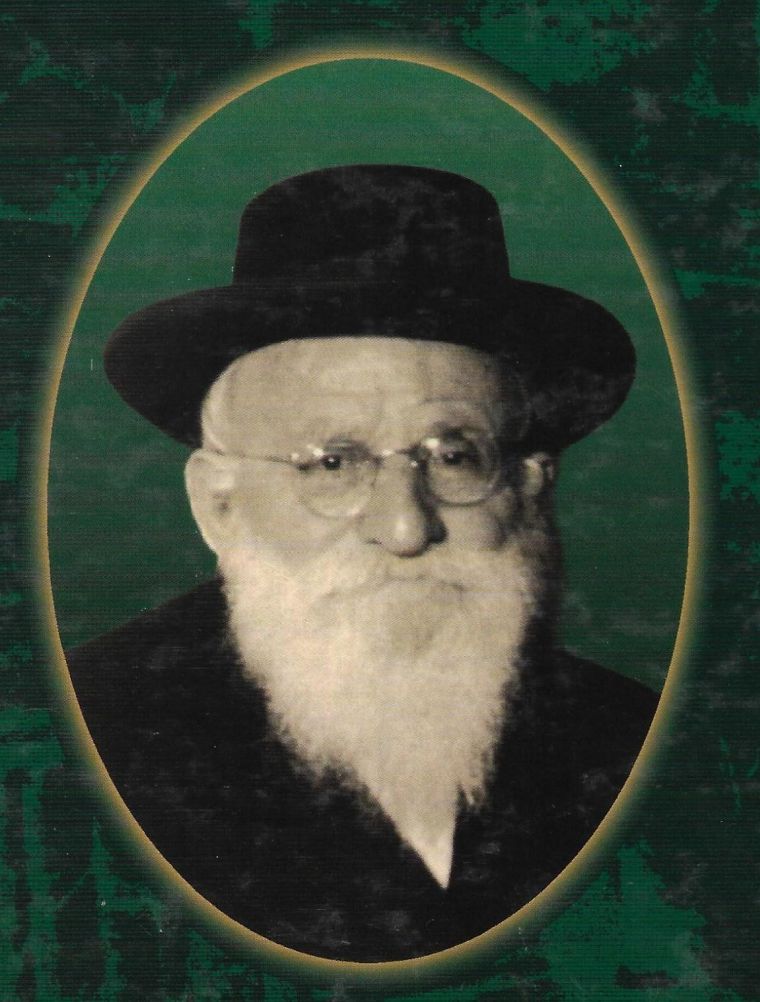
HaRav Moshe Porush zt"l

The Protests
All elements of chareidi Jewry joined to protest by any means available the construction of a mixed swimming pool in the Holy City of Jerusalem. They were opposed by the secular desires of the political leadership and the greed of a businessman, Haim Shiff, for whom the times were smiling. The politicians were out to provide one of the secular "amenities," a mixed-swimming pool, and the businessman to make money. The chareidi community, hoping to preserve the kedusha of Yerushalayim, went, individually and en mass, to jail in this battle over the sanctity of the Holy City.
Wall posters called for a day of prayer. In the afternoon, many of the neighborhood residents congregated at Yeshivas Meah Shearim.
"How did this outrage occur?" cried Rosh Av Beis Din R' Pinchas Epstein with emotion. HaRav Yehoshua Sheinberger and HaRav Amram Blau also addressed the crowd. Then, the latter went out on the mirpeset and fervently called out to those present: "Yehudim, let us take to the street!"
Together with HaRav Sheinberger, he marched at the center of the demonstration.
The demonstrators marched in the usual path, in the direction of the Strauss-Hanevi'im intersection. Patrols were already waiting there. A line of police officers led by second-in-command D. Wilk blocked the way, preventing the demonstrators from advancing. The demonstrators came to a halt, and began reciting Tehillim. "From the depths we call to you," they cried heartrendingly.
The senior officer raised his loudspeaker. "I hereby proclaim this to be an unlawful procession," he cried, and commanded the demonstrators to disperse. "If you don't, we will be compelled to use force. I'm giving you three minutes!"
No one moved. Suddenly, a fire hose shot forth a strong jet of water. The police officers swooped down on the masses, beating them brutally. Elderly people who were unable to flee quickly enough were wounded. An officer caught a youth and proceeded to strangle him. The youth escaped only with the help of a passerby. Women and children were also struck violently.
A Police Riot
The area looked like a battlefield. The broken cries of the wounded added to the pogrom-like atmosphere. One youngster, who was severely wounded, was transported to the Ziv hospital for treatment. Many arrests were made, and the chareidim, intimidated by the police, were afraid to pass through the area. The latter set upon the demonstrators with the intention of apprehending as many as possible.
Approximately twenty people were seized and handcuffed, among them HaRav Amram Blau and his son Uri. Although R' Moshe Porush tried to secure their release, all his attempts proved futile.
Indictments were quickly prepared. Judge Bazak refused to preside over the case, and the file was transferred to Judge Noam. The accused were transported in two groups. When asked if they understood the charges against them, one responded "Go talk to the wall."
Another complained that his glasses had broken in the police station, where he was slapped twice in the face. The prisoners were released on bail. They left, singing Utzu eitza vesufar.
The Political Perspective
On Sunday, the Jerusalem Municipal Council met as usual. Everyone knew what Rav Moshe Porush would want to discuss. It was Agron, the mayor, who surprised them: "The police only acted in self-defense," he claimed. He also warned that in the future, they would continue to conduct themselves as they had during this first demonstration, perhaps using even greater violence.
Many of those present were astonished. Since when had the mayor become a spokesman for the police? What right did he have to threaten the religious community in the name of the police force?
Here, Agron unwittingly revealed the connection between actions of the police and the desire of the municipality. He unintentionally demonstrated the subjectivity of those appointed to uphold law and order. Agron's refusal to see the delegation of rabbonim who had requested a meeting with him only served to intensify the feelings of rage and unrest.
At the same time, the secular press published slanderous and defamatory articles: Davar saw—or wanted to see—Yerushalayim as a secular city. Where did the religious get the chutzpah to retard Jerusalem's growth, compelling it to remain "primitive" and "backwards," closed to the spirit of the time? What unmitigated gall they had, trying to force a way of life on Jerusalem's residents that dated back to the Ottoman rule.
LaMerchav and Al HaMishmar felt that the secular character of Jerusalem is already a foregone conclusion, and that most of its residents demand it. LaMerchav: "We, along with our children, want a different Jerusalem. We wish to restore at least a bit of its glory as the capital of the Jewish nation."
The Real Issue
Indeed, the early Zionists wanted to do away with the city's Jewish tradition. A spiritually empty generation rose up; a generation which mouthed meaningless platitudes and desecrated all that was holy. The founders didn't want to raise a generation in the spirit of Vilna or Mezhibuzh, and they were unable to raise it in the spirit of Yerushalayim. They therefore decided to transform Yerushalayim into a secular city.
R' Moshe Porush responded to the newspaper statements concerning the city's majority. He said openly to Agron: "You and your partners in the coalition forget that during the municipal elections, you received fewer votes than the factions who today constitute the opposition. Let me remind you of the numbers:
"The parties in the coalition today received a total of 28,233 votes.
"The factions that are in the opposition received a total of 30,137 votes.
If you and your Mapai colleagues would consider for a moment, you would realize that you don't represent the majority in this city."(Hamodia)
Regarding the comment that "most (Jerusalemites) demand it," (i.e. a secular city,) R' Porush remarked: "Besides, what difference does it make which side the majority is on when it comes to issues involving the sanctity of Israel?"
Illegal Building
Meanwhile, construction on the pool continued without the requisite permits from the central committee in charge of building. Apparently, the law is only enforced when it comes to the religious. Despite the absence of a building permit, Agron encouraged the builders to continue.
The religious bloc quickly took out a court order calling a halt to all construction. On his part, Agron hurried to arrange the necessary building permits. The municipality took revenge by halting the construction in Shikun Pagi. (A religious neighborhood.)
At that time, Knesset member R' Menachem Porush was in America. He told me the following: "While in the States, I received a telegram from Yerushalayim, signed by many of her gedolim. Among them were: HaRav E.Y. Zlotnik, HaRav S. Schreiber, HaRav Fischel Rosner, HaRav Dovid Tzvi Gotstein, and HaRav Y. Brim.
"They requested that I broach to HaRav Aharon Kotler the idea of arranging a large demonstration in New York on chol hamoed. According to the plan, a demonstration would take place on the same day in Yerushalayim. When I showed the telegram to HaRav Kotler, he responded that if Maran the gaon av beis din of Brisk agreed, he would give it his full backing.
"When I returned to Eretz Yisroel, I spoke with the Brisker Rav. He listened to everything I had to say, but refused to respond to the idea of a demonstration. At that point, no demonstration was arranged."
Neturei Karta did stage a demonstration in America. There, as in Eretz Yisroel, everyone was aware that Yerushalayim lacked more important and essential facilities than a mixed-swimming pool. Large notices covered shul walls and full-page ads were taken out in Yiddish newspapers. Posters were plastered in Times Square and other central locations throughout the city.
Many New Yorkers stood dumbfounded before the pictures, which depicted police beating religious Jews sporting beards and payos. "Democracy? Is the blood of religious Jews worthless?" screamed the caption beneath the picture.
Taxis, equipped with loudspeakers, drove slowly through the streets, explaining to New Yorkers that the pool was full of blood, not water. They also called upon the community to attend a rally which would take place on Sunday at three.
The auditorium in the Manhattan Center was jam packed. "Dance, Musical Entertainment!" flashed the marquee outside the entrance. This time, the audience was of a different sort. Approximately five thousand people filled the hall, overflowing into the street outside. The speeches, given in Yiddish, were translated into English. The translator went outside for the benefit of the crowd outside. He approached the Chief of Police and his officers, who were on the scene, and proceeded to explain the difference between the cultured New York police and their brutal Israeli counterpart.
Gedolim were opposed to these initiatives, and their followers therefore took no part in the demonstrations.
End of Part 2