| | Feature
Jewish Blood for Jewish Money: The Story of 'The Europe Plan'
By Sammy Kaufman
Rav Michoel Dov Weissmandl zt"l
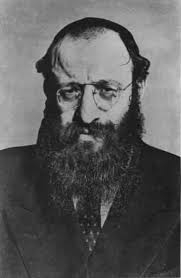
For Part III of this series click here.
This was originally published in 1995.
Part 4
The European heroes continued to ask for a response while all the worldwide Jewish institutions failed to respond, even after the Germans extended the deadline and actually halted deportations while awaiting a response.
The Deadline Passes
On the twenty-first of July, Schwalb wrote to Pomerantz, Bader and Schind in Constantinople, "Gisi is dissatisfied with the promise of two hundred thousand... She says that part must be paid to Willi immediately. She is right, too."
Schwalb proposed a joint arrangement between the yishuv and the Joint whereby Mrs. Fleischmann would receive two hundred thousand Swiss Francs (around fifty thousand dollars). "Think about it and send us an answer in principle by telegraph," he wrote. "In my opinion, you can do it. Then Gisi can have two hundred thousand Swiss Francs straight away." (C.Z.A., quoted by Fuchs)
On the third and the sixth of August, "The members of the delegation in Constantinople sounded the alarm in a letter [that was] sent to the Jewish Agency, the Rescue Committee and the Histadrut's Executive Committee. They felt that they 'must give Gisi the down payment for Willi' and argued against both themselves and the institutions of the yishuv that 'we are limiting her power to rescue... We are spending the entire remainder of the budget which you placed in our hands but it does not even cover one third of the down payment. We remind you of what we have said on this subject several times and we feel wretched indeed that we did not manage to convince you in time... Leave all your work for a short time and help to save lives, before the curtain goes down on everything." (C.Z.A. quoted by Barzel)
"Bader considered publishing Rav Weissmandl's letter in Al Hamishmar, so that the resulting pressure of public opinion would lead to the authorization of the payment to Wisliceny," (Horowitz in an interview with Bader in 1981.)
The urgency of the messages from Constantinople, possibly as well as Bader's threat, put the Zionist leadership in an uncomfortable position. On the tenth of August, Shertok sent a telegram to Saly Meyer, "After thoroughly studying the material I have reached the conclusion that we are shouldering a tremendous responsibility and placing a great burden on our consciences by not taking up Gisi's proposal. We are contributing fifty [thousand dollars] to the project and urge you to immediately give a hundred and fifty [thousand.]" (Yablonka, Porat)
A meeting of the Mapai Central Committee was held on the twenty eighth of August. "Haft and the others who spoke at the meeting about the rescue of Jews, were basing themselves upon the communications from Bratislava. Haft, who had been entrusted by Mapai with job of fundraising, approached [Ben Gurion] carefully but decisively. He asked, 'Ben Gurion not to get angry.' [He wished to know,] 'Why can't funds be made available for such a project, in the same way that they are for aliya, or that half a million liras was given for settlement [purposes?]... And I say that this is not [even] a lot.'
In his reply, Ben Gurion was forced to supply clear definitions, while snubbing Haft at the same time. He agreed with Haft that 'Eretz Yisrael could make a greater effort... but if you are thinking of Keren Hakayemet or Keren Hayesod... why are you speaking in such terms? What is all this, Haft?' The unequivocal conclusion [which Ben Gurion expected to be drawn] was that it should be quite clear that 'The institution known as the Jewish Agency is the entire Jewish nation's organization for building Eretz Yisrael,' [our emphasis.]
Ben Gurion went on to respond to a point that had been made by Vanya Pomerantz. 'It's true that it is sometimes more important to save one Jewish child from Zagreb than it is to build an entire school in Eretz Yisrael,' however, these were two distinctly separate things and 'this confusion which we are introducing... who does it help... why confuse the issue?' Ben Gurion declared that the Jewish Agency had 'taken upon itself to 'rescue Jews through aliya.' While it could be that it was more important to save other Jews, as Vanya had said, '[for that] there would have to be a different organization and other money.'" End of quote. (Barzel, from Beit Berl, Mapai Central Committee)
Once again, Ben Gurion emerges as the principal obstacle to the rescue of European Jews. Even after the hearts of his colleagues in Switzerland, Turkey and Eretz Yisroel had softened in response to the incessant entreaties and begging of the members of the Working Group, who had to stand before the Nazis empty-handed, he stuck to his guns. What was he expected to do about saving a Jewish child from Zagreb or about rescuing Jews who were not Zionists? How important were these needs next to building the Land?
So it was that even at this stage, the yishuv refused to pay any ransom money, beyond the fifty thousand dollars which Shertok had promised Meyer—and even that was still only a promise. Seventeen days after Shertok had cabled Switzerland, on the twenty-seventh of August, Dubkin wrote Gruenbaum, "We have decided to take part in the first stage of 'the Rabbis' Plan,' to the sum of twelve thousand liras (presumably these are the fifty thousand dollars which Shertok had promised.)" (D. Porat) "Ten thousand liras were a mere ten percent of the conscription fundraising drive's monthly budget." (N. Barzel)
"The negotiations with Wisliceny continued in Bratislava on the twenty-seventh of August. At this stage in the proceedings, Himmler decided to end all consideration of The Europe Plan. Evidence of this is contained in Wisliceny's communication to G. Fleischmann upon his return from Berlin, concerning the decision of the 'Presidium of the Ministry of the Interior,' to cancel the Germans' agreement of the tenth of May to consider the Slovakian activists' proposals for ending the deportations." (N. Barzel)
"He [Wisliceny] informed them [the Working Group] at the beginning of September that it was impossible to conduct serious negotiations with a party that consistently postponed deadlines which had been set and that did not put forward any concrete proposals... Thus ended the negotiations between him and the Working Group that had been continuing for around a year, since October 1942." (Oscar Neumann, [one of the members of the Working Group] In The Shadow Of Death,)
Sigmund Forst with a picture of HaRav Weissmandl

What Could Have Been
"A sense of failure and of lost opportunity now accompanied the members of the Working Group. Mrs. Fleischmann wrote, 'It is hard for me to find words to express how saddened I am over the abrupt interruption of such promising negotiations by the enemy and his henchmen. To my regret, I cannot free myself of the idea that if we had had the necessary means several months ago, the discussions would have taken a course that would have been favorable to us.'" (N. Barzel)
"In her letters, Mrs. Fleischmann expressed her bitter disappointment over the outcome, the Group's belief that if they would have had the money in their hands, things would looked completely different and also her feeling of impending doom." (D. Porat)
To her dying day, Gisi Fleischmann never suspected that the leaders whom she so admired, had "more important" things on their agenda than saving European Jews.
In his letter to researcher Yablonka, Ondrej Steiner, another member of the Working Group wrote, "The Plan failed because the necessary funds were not supplied."
Here is what Joel Brand writes, "Reja Kastner: 'The Germans asked for two million dollars for the rescue of all the Jews in Europe. They were not given the money; this was a most serious blunder." (Joel Brand, In The Service Of The Condemned)
"In the spring and summer months of 1943, the rescue activists in Bratislava claimed that there was a real chance to bring The Europe Plan to fruition, in exchange for fitting payment, in other words, there was a realistic alternative to the policies of mass destruction... the Slovakian Jewish leadership's attempt to rely on the Zionist Movement and on the leaders of Jewry in the free world, was abortive... It is possible to judge the feelings of the delegation in Constantinople regarding the extent of the financial aid that was designated for the Diaspora, from a letter which accompanied Moshe Dachs and Melech Neustadt on their arrival in Eretz Yisroel in March 1944: 'You [in Eretz Yisroel] must sit down and listen [to the refugees' stories]. Perhaps it can now be said, with all the cruelty that it implies, 'There have been victims of money.' " (N. Barzel)
"There is no guarantee... that the destruction would have stopped if the first payment of two hundred thousand dollars would have been paid. Looking back, it is impossible to know. One fact is absolutely undeniable though, that for eight months, a simple and concrete proposal made by the Nazi leadership to stop murdering the Jews was circulating in New York, Jerusalem and London. The Zionist leaders knew about this proposal and they paid no attention... Two Zionist leaders, the heads of the World Zionist Congress—Stephen Wise and Dr. Goldmann—wrote memoirs... it is known that they both received copies of 'the Rabbis' letter' from Tratkover. Yet neither of them had a single word to say about The Europe Plan in their memoirs... a sure sign that they didn't waste any of their strength over it." (S. Bet Tzvi)
In The Blunder Of The Century (Al Hamishmar, twenty-sixth of April 1987,) Yoel Ben Porat writes, "The yishuv's economy was booming. Solel Boneh and the food industries were being established amid prosperity. The cafes of Tel Aviv were packed. Life went gaily on, instead of donning sackcloth and protesting every week... The primary concern of the Kibbutz Movement was the Dance Meeting at Dalia. The almond trees were blossoming in Canaan while over in Europe, the slaughterer was busy. A group of young men were posted in Constantinople, emissaries of the Jewish Agency, amongst them were Menachem Bader from Mizra and Vanya Pomerantz... they despatched stirring letters, requesting money for rescue but they may have been shouting in a desert. The Jewish Agency, which was in possession of detailed and up to date information about what was happening in Europe, devoted most of it's time to empty discussions and trivialities—whether to award the staff a raise... nobody was involved in rescue"... "After the Plan's collapse, an increase in the pace of the murders, from August 1943." (S. Bet Tzvi)
Ben Gurion addressed the Rescue Drive on the twenty-third of September, 1943. "I would simply like to tell you that if, in some city or region, lives are being saved through various means—such means as will not be effective in cancelling the decree without the payment of money—then the meaning of such cancellation is the single step between life and death..." T. Frieling comments, "This may have been an allusion to the Slovakian experience."
In the same speech, Ben Gurion also lamented, "What fate awaits the remnant?" And in a speech to the conference of the United Kibbutz Movement on the nineteenth of January 1944, he said, "It is good that from time to time, we unite with [the memory of] those who were driven on the death trains and who died with Hatikva on their lips."
At this point T. Frieling comments, "We have mainly concentrated on one topic in an effort to portray Ben Gurion as a man who was well-acquainted with the byways of rescue, both in principle and in practice.
After reading all the above, we may certainly find ourselves in agreement with Frieling's contention that Ben Gurion was well acquainted with the options for rescue. The title of Frieling's article is also an apt one, Ben Gurion and the Destruction of the European Jews. Perhaps his next study could examine the dichotomy between the public utterances of political leaders and the opinions they voiced inside closed meetings.
S. Bet Tzvi has the following to say of Rav Wiessmandl, lehavdil, "Rav Weissmandl's letters, which were written in a frenzy of desperation and rebuke, did not achieve their end. When the time comes, they may well be recognized as the most disturbing documents from the holocaust period."
Dinah Porat on the other hand says, "Wiessmandl has not been scorned in Eretz Yisrael for his harsh letters for 'a man is not taken to task for [what he utters in] his anguish,'" a sentence which reveals much about the historical biases of its author.
Writing about The Europe Plan after the War Rav Wiessmandl said, "Fifteen years have passed since that day in Tammuz 5702... and still my pen refuses to write the truth, for it is a bitter and fearsome truth... Between that day in Tammuz... the blood of thousands upon thousands all over Europe was up for sale... but there was not a single one who listened to the scream for blood money, nor was there a single savior. There was no one to rescue, nor to redeem Jewish blood for Jewish money. Jewish blood was up for sale—nobody would buy it with Jewish money. The truth is indeed bitter and fearsome, for matters of life and death were pushed aside on account of squabbles over money. How great is the sin which appointed Jewish leaders whose blindness led them to value the blood of the entire Jewish Diaspora as not even being worth a farthing." (Min Hameitzar)
The Grave of Rav Weissmandl

Postscript: What Became Of The Money?
The above documentation leads to the inescapable conclusion that The Europe Plan failed—in fact no serious attempt was ever made to carry it through—because the money did not reach Wisliceny... It is therefore probable that despite the decision to designate twenty-five thousand liras (one hundred thousand dollars,) as the yishuv's portion of the down payment to Wisliceny, the money was not transferred at the right time." (N. Barzel)
From the comments of Prof. Bauer and Dr. Porat, it emerges that money was indeed sent from Eretz Yisroel. D. Porat writes, "After much indecision and hesitation, the Jewish Agency's directorship decided not to let the opportunity go by—despite the fact that they considered the entire deal extremely suspect—and together with the Joint, to pay the two hundred thousand dollar down payment requested by the Germans. The money was transferred according to Shertok's directives and in accordance with a verbal agreement between him and the Joint."
In 1981, Prof. Bauer wrote, "During the summer, the Jewish Agency transferred fifty thousand sterling (two hundred thousand dollars,) to Constantinople but it was too late." (Bauer, Historical Perspectives on the Holocaust, Tel Aviv 1981.)
In 1983, he wrote, "Their [Rav Weissmandl's and Mrs. Fleischmann's] demands reached the Agency and Sharrett was undecided. Ultimately, he decided to pay. The transfer of fifty thousand sterling to Constantinople began and the first fifteen thousand were transferred from Constantinople to Slovakia.' (Bauer, Reactions During the Holocaust, 1983)
And in 1984 he writes, "At the beginning of August, the group in Constantinople transferred all the money to Slovakia, as Dr. Porat wrote in her article in Ha'aretz on the thirteenth of April." (Bauer, The Deal, It's History and Distortion, Ha'aretz, twenty-fourth of May, 1984) Dr. Porat writes, "The promised hundred thousand dollars were despatched from Constantinople, in the care of a double agent."
What documentation exists to verify this conclusion? In a footnote, Dr. Porat writes that her source for the information is Teddy Kollek. "Concerning the amount that was sent from Eretz Yisrael via Constantinople, see Teddy Kollek's One Jerusalem, pg.59-60," she writes, going on to comment that, "Kollek was mistaken about the year, when he wrote that the monies were sent in 1944. By then, Kollek himself was no longer in Constantinople, Gisi Fleischmann had been incarcerated and The Europe Plan had long since ceased to be relevant."
Here is the passage in Kollek's book to which Dr. Porat refers. "We received information from Bratislava, the capital of Slovakia, from an extraordinary woman, Gisi Fleischmann, that much could be achieved by bribing senior figures in the Gestapo. She had already managed to establish a connection with Wisliceny... We sent money to Gisi and the members of her group. A surprisingly high percentage of enemy agents cooperated with us in a completely honest and upright fashion. The sole exception to this that I remember, took place in August 1944, long after I left Istanbul, when a hundred and fifty thousand dollars were sent to Gisi with one of the double agents. Several weeks later we heard that she had been executed. We heard nothing else about the agent and the fate of the money is unclear. It is possible that the agent was also captured and killed."
It would have been possible to pass the year 1944 off as a mistake, as Dr. Porat wishes to do, had this been the only detail which Kollek supplied. However, he himself adds the qualification that the episode took place 'long after I left Istanbul,' which suggests that the date is correct. He also refers to a sum of a hundred and fifty thousand dollars, a different one to that of one hundred thousand dollars mentioned by Dr. Porat. If this is correct, the sole source upon which both Dr. Porat and Prof. Bauer are basing themselves, would have been talking about an incident unrelated to The Europe Plan and would furnish no proof that any money at all was actually sent to Mrs. Fleischmann for that purpose.
Dr. Bauer told me in a telephone conversation that his investigations revealed that the bribe money for Wisliceny had indeed left Eretz Yisroel and arrived in Constantinople. On a different occasion, he said, he had spoken to Bader, Barlas and Pomerantz, members of the delegation in Constantinople, all of whom told him that fifty or sixty thousand ponds sterling had arrived from Eretz Yisroel. They divided the money into a number of smaller amounts and sent it with messengers to Slovakia. They claimed that all the money had been lost. I asked Bauer how it could be that every one of the messengers, who were known to be reliable, happened to lose this particular money. I also asked him who the messengers had been—throughout the War years, the same small, constant group of messengers had been employed. Bauer replied, "Those with whom I spoke did not remember the messengers' names."
Referring to the regular despatches of money to Slovakia, N. Barzel writes, "Upon examining the correspondence, it can be determined that the money sent to Slovakia from Constantinople arrived at it's destination... The messengers brought back signed receipts which were passed on to Bader. They had been personally signed by members of the Zionist leadership, Gisi Fleischmann, Oskar Neumann and Moshe Dachs."
Peretz Rabbes escaped from Slovakia to Hungary in 1942. While in Hungary, he was involved in rescue and aid efforts. He told me that the agents who took money from Constantinople to Hungary and the other countries of occupied Europe, were one hundred percent reliable. He doesn't remember a single instance when their missions were not successfully executed. The testimony of Barzel and Rabbes makes it look even stranger that the specific money intended for Wisliceny managed to get lost.
What a strange sequence of events! Large sums of bribe money were sent to Slovakia both in 1943 and 1944 and they simply were lost!?
End
|