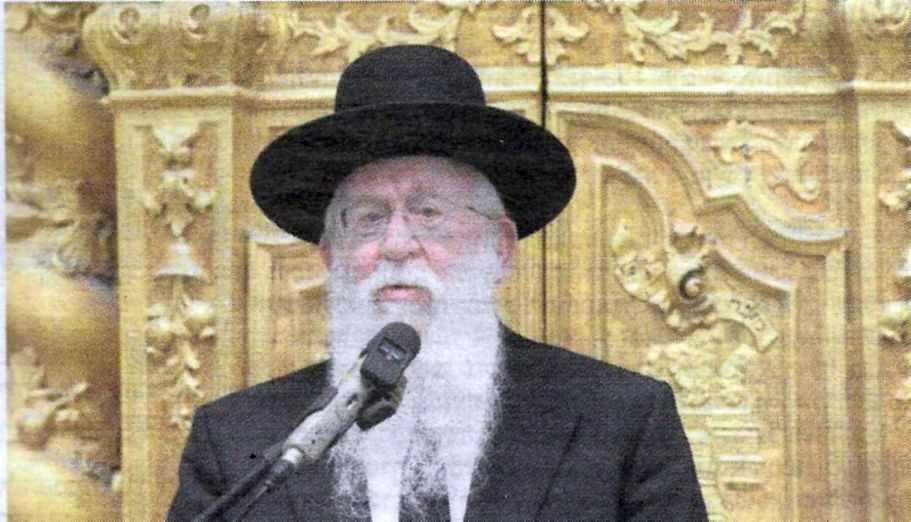
HaRav Yigal opens with an amazing story that he heard from an avreich from Petach Tikva who teaches in a Chinuch Atzmai cheder in Herzliya. A large community of French immigrants has developed in Herzliya who choose to send their children to other chadorim which offer a government curriculum of secular studies.
A week ago, an affluent French building contractor came to the Chinuch Atzmai. cheder, asking to enroll his son and another boy from the eighth grade. It is very unusual to accept a new student in the middle of the year, especially to the eighth grade, when only a few months are left until the end of the year. The father was naturally asked why and he replied that he wanted his son to continue on to a regular yeshiva ketana, but his present school does not do this.
"What has made you decide such a thing at this late stage?" the father was asked.
He replied, "Seeing how the government legal advisor is so aggressively and abnormally persecuting the yeshivos, I have come to realize that it must be the most important thing in the world. If so, I want my son to be part of that world, that he be implanted in this pure environment. Now! Immediately!"
How to explain this phenomenon?
We find in the Torah that Noach entered the ark "in the middle of that day." Rashi quotes the teaching of Chazal that the people of his generation declared that when they saw him entering the ark, they would demolish it and kill him.
Hashem said: "I will command him to enter in your full view and we shall see who can protest or prevent it."
We find this same sort of statement in leaving Egypt, as well as with the death of Moshe Rabbenu. These are understandable.
But how does this similarly relate to Noach? Why should his entering the ark make a difference to the people of his generation?
The answer is that even a wicked man admits the truth while refusing to acknowledge it. At the moment of truth, he will attempt to destroy that truth and refuse to see it.
This holds true for our situation as well. 'They' know in the confines of their hearts that the Torah and the world of Torah and yeshivos represent the pure truth but refuse to admit it; they are determined to destroy it! This should obligate us to cling to this truth, and in these very days, to realize the significance of receiving the Torah and how we are expected to become implanted in the House of Hashem.
In a week and a half, we shall celebrate Shavuos. What does this 'receiving of the Torah' give us each year?
HaRav Rosen: The Torah was given 3337 years ago (It is erroneous to believe that the Torah was given in year 2248. The mistake lies in the Order of the World, when the count should begin with the creation of Adam and not the year of 'tohu' (oblivion), which therefore sets the giving of the Torah at year 2449.)
The question stands but we study Torah, surely. What, then, is meant by Kabbolas haTorah, the receiving the Torah (anew)?
There is a wondrous teaching of Chazal which throws light on the subject: "Throughout the forty days when Moshe Rabbenu was in Heaven, he learned Torah but repeatedly forgot what he had learned. He said to Hashem: I have been here for forty days but I have not retained a thing."
This is not understood. He had the greatest pedagogue possible. The very Creator taught him! How then could he declare that he didn't know a thing?
The Medrash continues: During the forty days, Hashem bequeathed the Torah to him as a gift. Again we ask: So what? If was a gift, does this imply that he would not remember what he had learned?
We must then contemplate the meaning of kabbolas haTorah, the receiving of the Torah. Torah is not simply a conglomerate of knowledge; it is the acquiring of Torah. Torah is a reality, an abstract reality which existed before Creation. It was this reality which Hashem bequeathed to Moshe as a gift.
Moshe Rabbenu did not simply ingest knowledge or information. On the contrary, he felt as if he 'did not know a thing.' At the completion of the forty days, Hashem gave him the Torah as a reality. Why, then, not at the beginning of this period? Because he needed this period of not eating or drinking in order to divest himself entirely from materialism in order to receive the Torah as an integral part of him.