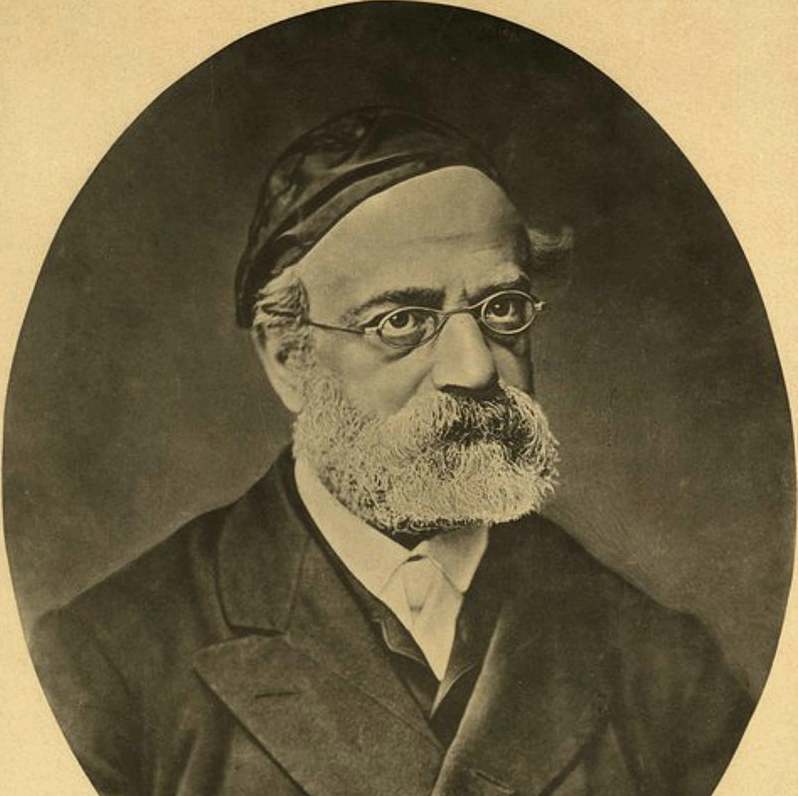
HaRav Samson Rafael Hirsch, fighter against Reformers
Introduction: The Past As A Guide To The Present
Originally published early in 1995, this review of the early days of the Reform movement has not lost its interest or relevance.
*
Part II
Dismissing A Nation's Dreams
In another of his accounts, Behr describes Tishah B'Av in the Dresden temple. The customs of this day have always served as a target for ridicule by heretical elements who mock the age-old Jewish desire to leave the exile and its attendant tribulations.
This then, was a different kind of Tishah B'Av. Those who arrived on the eve of the fast wanting to remove their shoes, were asked to kindly do so in the entrance corridor and to then put on some other suitable form of footwear. Bringing in low benches was forbidden and sitting on the floor was unthinkable. The day's ceremonies were carried out "in a restrained manner and without shrieking."
On Tishah B'Av morning, Fraenkel gave a sermon in which he made reference to the Damascus Libel, which was then a hot topic throughout the Jewish world.
"Innovations"
Siddurim were altered at a hectic pace. In the Autumn of 1817, Klei and Ginzburg began work on a new, two volume siddur. This was an amended version, which testified eloquently to the extent of the devastation which the new movement had already wreaked. The Amidah was to be said just once, by the entire congregation in unison. There was no silent Amidah. A marked preference for nusach sepharad is noticeable, which went hand in hand with the reformers' tendency towards the Sephardic pronunciation.
A look through these amended siddurim clearly reveals another deliberate intention. The two German Reform siddurim miss out, in the brocho of ahava rabbo, the request to `bring us in peace from the four corners of the earth and make us go upright to our land.' The ongoing process of normalization with the surrounding German culture rendered it meaningless, in the reformer's eyes, to ask for a revival of an ancient Jewish theocracy.
The term `moshiach' was exchanged in German translation for the abstract `redemption,' meaning a concept of universal perfection. Kol Nidrei, which opens the prayers of Yom Kippur, was dropped, apparently out of concern about antisemitic elements who read in it the abolition of all agreements between Jews and Christians.
The degree of change did not remain static. As soon as one alteration had been introduced, another one appeared upon—or more accurately, darkened—the horizon. The first reformers were upset by the references to the renewal of animal sacrifices in davening. On Yomim Tovim they therefore requested that `You accept with mercy and goodwill the speech of our lips,' rather than `our obligatory offerings.'
In Hamburg, Oleynu Leshabeach was said only on the High Holydays. The reading of a haftorah was abolished and even the reading of the Torah was abridged by the introduction of a three year cycle for completing the Torah. The systematic rejection of all references to the return to Eretz Yisroel laid bare the undermining of the foundation of Jewish faith in the coming of moshiach and the revival of the dead.
One thing led to another. What had started out as the mere adoption of certain aesthetic elements from the gentile culture soon became something entirely different. What was supposed to have been the copying of an outer form, an imitation of `the beauty of Yefes in the tents of Shem—even if it was in fact something of an imitation of Yefes himself—quickly plunged Reform into the abyss of heresy.
Abraham Geiger who, more than any other, is usually thought of as being the Reform Movement's progenitor, pioneered the field of Bible Criticism, which sought to destroy the very foundations of the Jewish faith. Another of the pseudo-Jewish movement's architects, Samuel Holdheim, a radical reformer who even supported mixed marriages, left a large number of written works in which he spread his own brand of heresy. These works contained, in the form of `historical studies,' his own preconceived ideas about the `development of the Jewish halacha,' down to his day.
A Valiant Defender
The Reform Movement cannot be discussed without making reference to the first and the leading fighter in the battle to preserve authentic Judaism—HaRav Shimshon Rafael Hirsch zt'l.
HaRav Hirsch can be credited with nothing less than the preservation of faithful German Jewry. He was viewed by his Jewish compatriots as a thinker and a superlative representative of authentic Judaism as well as being one who did whatever was possible to halt the spread of Reform. The published Shemesh Tzedoko Umarpeh contains HaRav Hirsch's teshuvos on subjects spanning all four divisions of Shulchan Oruch, revealing him not only as the author of Igros Tsofun (Nineteen Letters) and a commentary on the Chumash, which contain a wealth of ideas on Jewish thought, but also as a gaon and a poseik, who ruled on contemporary questions.
HaRav Hirsch was thoroughly acquainted with the ills of his generation. Although he received a traditional Jewish education, he spent a year studying at the University of Bonn (but he did not get a degree). He was fluent in the Classics and in German literature. Armed with this intellectual weaponry, he was able to blaze a trail in the battle in which he found himself engaged against those who disguised their wish to tear Judaism apart as an `innocent' intellectual exercise.
Much has been spoken and written on the subject of HaRav Hirsch's Torah im derech eretz outlook. Some viewed this program as an ideal and as a course to be followed throughout a lifetime. Others were of the opinion that it was successful in one particular place at a particular time, when no alternative was possible. All sides of the debate agree, however, that for a generation under attack by Reform, it was an absolute necessity, in order to halt the rapid spread of the movement that was laying German Jewry waste.
HaRav Hirsch's views have been gathered together in his writings. From 5611 (1851,) he served as the rav of what was initially a small Orthodox congregation in Frankfurt. In his younger years, he imagined that he had the support of most of German Jewry but later on in life, he realized that he was only supported by a small minority.
Sadly, HaRav Hirsch's experiences in Frankfurt proved to be a model for the entire Jewish world in the coming generations. A century and a half ago, dense Jewish population centers such as the cities of Pressburg and Vilna, were still far from resembling Frankfurt, where only a handful of bearers of the pure, authentic Torah message were to be found. Most of the city's Jews, even if they tended more to being simply irreligious than to being reformers, were nevertheless far from Orthodoxy. Both groups shared a common agenda, namely, the provision of moral justification for a spiritually undemanding life—nobody ever denied that being a Reform Jew is far easier than being a faithful Orthodox Jew.
The Movement Takes Root: The Braunschweig Conference
The reforming ideas took root and their proponents gained leadership over many of the Jewish communities in Germany. During the years 5604-6 (1844-6), three `rabbinical conferences' were held in Braunschweig, Frankfurt am Main and Breslau.
The most famous of these was the first, the Braunschweig Conference, whose heretical resolutions provoked a storm of protest on the part of faithful Jews. This conference is usually looked upon as the first in which Reform was founded as an official movement with members. At Braunschweig, the foundations for a movement with a mass following, whose motto was to be the remodeling of Judaism—whether at the hands of those who wanted to see its radical alteration or those who wanted to preside over its gradual modification.
Although the delegates were intellectuals, they were for the most part ignoramuses as far as Judaism was concerned. They were mostly young people in their thirties, who had been born and bred in Germany. Many of them were `preachers'—rabbiners as they were called in German. A number of them held posts in large communities such as Hamburg, Frankfurt and Breslau. Others owed their fame to their literary accomplishments—it was their works which in fact formed the Reform Movement's manifesto.
Interestingly enough, a positive attitude towards reform was not a precondition for obtaining an invitation to the Braunschweig Conference. In theory, nothing would have prevented the Conference's having been controlled by a majority of faithful rabbonim, or at least of staunchly traditional lay leaders, who would have placed upon it an unmistakably conservative imprint. However, even if this were to have happened, it is fairly certain that the reformers would have found some other direction in which to break out and pursue their ideas. In any event, not a single Orthodox rav participated in the Conference.
The right wing at these conferences usually contained a few delegates who basically believed in the supreme authority of the Bible and the Talmud while favoring a few, mostly formal changes, within the framework of what they still considered to be halacha. Throughout the debates, they would stand out because of the yarmulkes they wore on their heads.
Similarly, there was also a small, extreme group of left wingers whose chief spokesman was Samuel Holdheim. He and his friends sought the complete remaking of Judaism in accordance with `the spirit of the times' and in utter disregard of even the sort of pseudo-halachic `historical precedents' with which the other delegates to the conferences tried to bolster their proposals.
With the exception of a few issues where the right wing won the support of the large middle bloc, it was usually overruled by the rest of the delegates. Although the central bloc was the largest, it was also the most varied. Its members waved aloft the banner of departure from tradition, invoking pseudo-intellectual `historical precedents,' which enabled them to preserve some illusion of belonging to one historical continuum with Jewish history.
The Braunschweig Conference opened on the twelfth of June, 1844 and lasted for eight days. It was perhaps the first occasion since the destruction of the Beis Hamikdash seventeen and a half centuries earlier, when the most sacred precepts of the Jewish faith were put to the vote. It signaled the beginning of the greatest spiritual holocaust in Jewish history, one hundred years before the end of the holocaust which the Nazis unleashed upon European Jewry.
The Kelmer Maggid, Rav Moshe Yitzchok Darshan made the following comments concerning the Reform Movement, that uprooted the Shulchan Oruch: "The Germans will not simply persecute Jews. They won't just oppress Klal Yisroel when they arise against us. They will made antisemitism their Shulchan Oruch, R'l!"
"Heed my words," the maggid once said in a moment of near prophecy, "For the sin of Geiger's Shulchan Oruch, a new, German-style Shulchan Oruch will be enacted against us, R'l, where the command, `Kill the best and finest Jews!' will be written. May Hashem watch over us and spare us."
The maggid's predictions, which were made decades before Hitler came to power, were recorded by Rav Yaakov Mazah, a personal acquaintance of the maggid, in his memoirs.
Continued ...